You have paid for creator videos without knowing which channels the usage window covered. The rights line is the one nobody audits, and it decides whether the file stays yours. So how much of that invoice was just permission to keep using it?
Half the field is teaching people how to become a UGC creator, and almost none of it is written for the person paying. So the brief you send next month gets assembled from three creator-side blog posts and a rate card, which is how a $1,200 Reel ends up licensed for a window nobody on your side chose. The exposure is not the fee. It is the ad still running in week fourteen on permission that expired in week thirteen, and the takedown request that follows it. Which means the file you are scaling right now has a date attached to it that nobody has looked up, and the last place you would find that date is the invoice.
The Question Everyone Answers Instead of This One
UGC is content made by someone other than your brand, either published on their account or handed to you as a file you own the right to use. A UGC creator is the person you hire for that asset. The useful distinction is not creator versus influencer as job titles, it is what the money buys: with a UGC creator you are paying for the creative, and with an influencer you are paying for access to an audience they already built. Emplifi states that split cleanly on the page currently ranked first for this term, and it is correct.
That page also carries a section titled "How to brief UGC creators for high-performing content", so the brand-side framing is not a gap anybody needs me to fill. What that section is: four paragraphs of framing with no checklist, no file specification and no rights line, which tells you the brief matters without telling you what goes in one. Cohley's brand buyer guide, a few positions lower, is a genuine procurement document that scores six platforms across eight axes including rights and compliance. It scores software, not the deliverable.
Now look at where the numbers live. Every page carrying real figures on this query family is written from the creator's side of the table: what to charge, what a beginner should ask for. The two decisions a buyer actually has to make, what the file must contain and what the usage window costs on top of the fee, are priced nowhere on the brand side. That is why the next section is a table instead of an argument.
One adjacent purchase gets confused with this one. Software for casting and creator outreach is a UGC content platform decision with its own pricing shape. What follows is about the deliverable and the license, which is what the buyer is really signing.
What a Brand Actually Orders
A creator quotes one number. What arrives is four or five line items, and the gap between quote and invoice lives in which of them were named. No rate card captures it, because a rate card prices a video and a brief prices a set of rights and files.
The deliverable set
Line item | What it should say in writing | Why it moves the price |
|---|---|---|
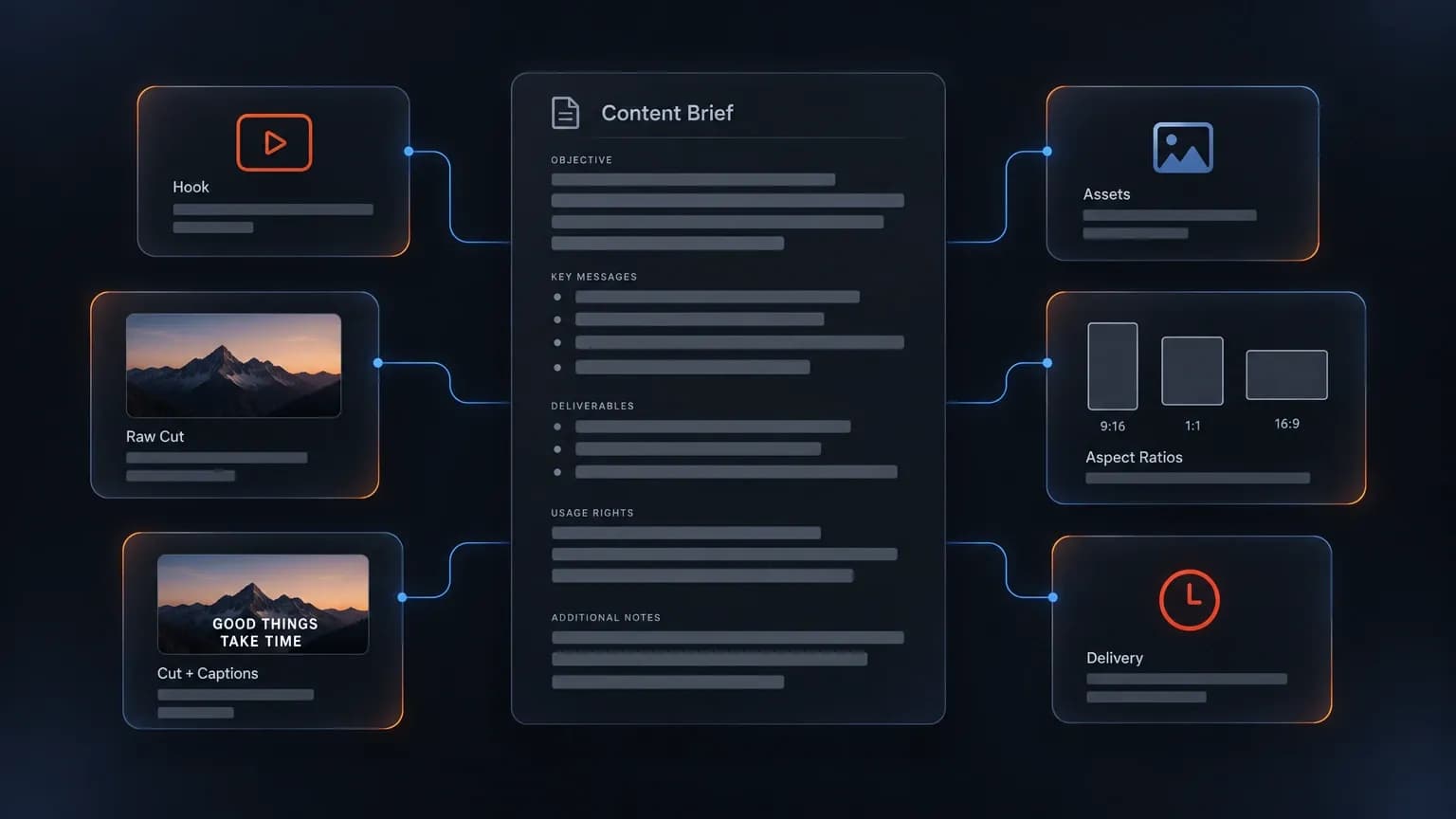
Hook variants | Three openers, first two seconds, delivered as separate clips | Lets you test angles without a reshoot. Omit it and you bought one hook at full price |
Raw footage | All takes, before music and colour grading, unedited | Your editor can recut for a different offer in six months |
Edited cut | Duration named, captions burned in, no licensed audio | This is the item most quotes are actually pricing |
Aspect ratios | 9:16, 1:1 and 16:9 in one delivery | Reformatting it yourself costs more than the shoot did |
Captions | Burned in, plus an SRT file | The separate subtitle file is what makes the asset re-editable |
Revision rounds | A number, and a definition of what counts as a round | "Unlimited revisions" in a quote usually means one |
Delivery | Format, resolution, destination and a date | A delivery date is a campaign dependency, not admin |
Whitelisting permission | Named explicitly, priced separately | Without it you cannot run the ad from their handle |
The creator's rate is rarely what separates a $150 quote from a $600 one. What separates them is how many of those eight rows the proposal names, and whether the missing ones get billed later.

Usage rights and the window, priced separately
Emplifi is right that a creator's fee normally covers reuse across organic posts, paid ads and product pages. What no brand-side page prices is the window over which that reuse is allowed, and the window is where the money is. Time-limited rights are sold as a percentage added to the base fee, and the ladder looks like this.
Window you are buying | Added to the base fee | What it allows | The catch |
|---|---|---|---|
Organic repost only | 0% to 10% | Posting the file from your own accounts | Permission to post is not permission to advertise |
30 days, paid social | 20% to 30% | Running it as an ad from your ad account | Renewal is priced again, never grandfathered |
90 days, paid social | 30% to 45% | The same, across a full quarter | The band most campaigns actually need |
12 months | 70% to 100% | A year of paid use | Past a year, price a new shoot before renewing |
Whitelisting, ad served from the creator's handle | 25% to 35% per 30 days | The ad appears to come from them | Priced per period, so three months costs three times as much |
Perpetual, all channels | 150% to 300% | No expiry and no renegotiation | Usually the most expensive way to buy the same file |
The duration bands come from a 2026 agency compilation that attributes them to Influencerfee, with the whitelisting band credited to Storika and cross-checked against Modash at 25% to 100% of base and impact.com at 20% to 50% of base per month. That is third-party trade guidance assembled by an agency, not a measured survey, so use it as a negotiating range. The shape of it is what matters: at the top of the ladder the rights fee is larger than the creator's fee.
The arithmetic that decides between the two ends. Take a $1,200 Reel. Ninety days of paid usage at 40% adds $480, so the license costs $5.33 per licensed day. A perpetual buyout at 150% adds $1,800. Divide that by $5.33 and the buyout starts paying for itself on day 338. Most paid social creative is retired long before that. Run the same division on your own numbers before you accept a buyout clause. Both figures are percentages of the same base fee, so the crossover holds at any budget: roughly 338 days whenever you choose between a 90 day window at 40% and a perpetual buyout at 150%. Only the ratio moves it, which is why the ratio is the thing to argue about.

Exclusivity, and when it is worth paying for
Exclusivity is a separate line, and buyers routinely fold it into the rights conversation where it does not belong. Usage rights govern what you may do with the file. Exclusivity governs what the creator may do elsewhere, and it is priced against total deal value rather than against the fee: 30 day category exclusivity runs 15% to 30%, and 90 days runs 25% to 50%, per the same compilation's attribution to Influencerfee.
Pay for it when a competitor naming your category in the same feed would undercut your campaign, and when the creator already works in that category. Skip it when there is no overlap. That trade, casting money against restriction money, is the working end of an influencer marketing agency engagement, and it is the decision most teams make by instinct rather than by arithmetic.
The Brief That Gets You a Usable File
A UGC creator brief is a one page instrument, and the version I would send carries fourteen lines. Get the lines right and you receive a file you can run. Miss four of them and you receive a file you have to reshoot. Here is the version I send.
The last four items are contract mechanics rather than creative direction, and they are the ones a friendly exchange of messages skips. A 2026 compliance guide from Auditsocials lists three requirements a creator contract has to meet beyond commercial terms: define usage precisely across organic, paid and whitelisted placements with platforms and duration named, assign disclosure responsibility to a named party in a named format, and require permissions to be granted through each platform's own official tooling. It is a compliance vendor documenting platform rules, so treat the framing as vendor guidance and the mechanics as platform policy. The failure mode is the one that should worry you: without a written grant you hold an implied license at best, and organic permission is not advertising permission.
No stack of SEO tools writes that rights line for you, and no template downloaded from a creator marketplace will assign disclosure responsibility on your behalf. It is a paragraph you write once and reuse, which is the cheapest thing on this page.
What It Costs at Each Scope
UGC creator rates published in 2026 diverge by roughly an order of magnitude, and the divergence is honest rather than noisy. Every figure below is vendor or agency published, and each measures a different population. This is also the step where a UGC content marketing budget usually goes wrong, by picking the row that matches the pitch deck rather than the brief.
Scope | Published band | Source, dated |
|---|---|---|
Basic talking head, unedited | $75 to $150 | Hubfluence, vendor calculator, 2026 |
Standard edited video | $150 to $300 | Hubfluence, 2026 |
Average single video | $100 to $250, clustering $150 to $200 | Launchpoint HQ, agency, June 2026 |
Premium scripted | $300 to $600 | Hubfluence, 2026 |
Experienced creator, multi scene | $400 to $1,000+ | Hubfluence, 2026 |
Average across verticals | $150 to $212 | inBeat, agency, April 2026 |
Marketplace payout average | $154 | Collabstr marketplace data, 2025, reported by Digital Applied, September 2026 |
Buyer reported median | $500 to $1,200 per video | JoinBrands, vendor, August 2026 |
Premium and enterprise | $500 to $3,000+ | Insense, vendor, September 2026 |
Photos, three to five pieces | $200 to $800 | JoinBrands, August 2026 |
Two of those rows cannot both describe your situation, and averaging them produces a number that describes nothing. The $154 is what creators were actually paid on one marketplace; the $500 to $1,200 median is what one platform's buyers report paying for longer briefs with more usage attached. Pick the row that matches your deliverable set and window, then treat it as a starting point. One caveat before you anchor on it: much of the older rate commentary, including the widely repeated $150 median, traces back to a creator survey run in 2022.
The competing supply source you will be asked about. An AI avatar talking head ad costs roughly $0.39 to $3.90 per 30 second video at 2026 list prices, with Synthesia at $29 and $89 per month, HeyGen at $29 and $49, and Creatify at $39 and $99. That is two orders of magnitude below any human rate, and it is the reason this section has to address it.
Here is the honest half. Klaviyo's 2026 AI Consumer Trends Report, a survey of 7,998 consumers across eight countries fielded in November and December 2025, found that 32% trust a brand less when its content is low quality or generic AI output, and that 58% of its "Holdout" persona lose trust in brands that clearly use AI-generated content. The best evidence I have found comes from the other direction. A DTC operator who had publicly predicted that AI UGC would replace human creators retracted it 18 months later after A/B testing on Videowise brands, reporting that real customer video "did not beat AI by 5 or 10%. It beat it by a landslide on every PDP test we ran." That is one operator's self-reported test, not a study, and his conclusion was that the cost per video argument had stopped mattering.
So route by job rather than by cost. Product explainers, localization variants and high volume hook testing suit a synthetic presenter. Testimonials, and anything implying personal use of the product, need a real person and a visible disclosure. Synthetic presenters must be labelled on Meta, TikTok and YouTube, and an AI edit cannot create a claim the source footage does not contain. One counterpoint tells you where this is going: Icon sources real creators and advertises its output as "100% real, not AI", which makes authenticity a feature somebody can charge for.
If you would rather not run casting and contracting yourself, content creation agencies and content marketing services teams will buy this on your behalf, and the usage window is exactly where their quote and your expectation drift apart. Ask any of them how the window is priced as a percentage, and watch whether the answer arrives with a number in it.
Where UGC Fits Beside Paid Social
There are three ways a creator file reaches an audience, and proposals tend to blur them into one purchase. Reposting the video organically on your own channels is a content license. Running the file through your own ad account needs paid usage rights, the bands at 20% to 30% for 30 days and 30% to 45% for 90 days. Running the ad from the creator's handle is whitelisting, priced separately at roughly 25% to 35% per 30 days, and it needs platform authorization through Meta Branded Content settings or a TikTok Spark Ads code, because the ad account serving the creative is not yours. Knowing which of the three you bought is the difference between a compliant campaign and a takedown.
Within a paid social account, the case for creator assets rests on platform data, and it should be read as a vendor describing its own product. Meta's December 2025 post on its own A/B results reports that partnership ads delivered 19% lower cost per acquisition and 13% higher click through on average. Treat that as a platform reporting its own tests and then measure it yourself. The vertical cut you ordered is what a placement like Instagram Stories ads consumes, and the same file in a feed placement is a different creative job.
The measurement is where most UGC programs quietly fail. Follower count is not a number your business can act on, so give the placement its own line in the marketing KPIs you already report: cost per acquisition on the whitelisted version against the same asset posted from your own handle, and a second line for the share of licensed days you actually used. That second number tells you whether the window you bought was sized correctly, and almost nobody tracks it.
Conclusion
The deliverable set, the usage window and exclusivity are three separate purchases wearing one word, and the reason the invoice line is unauditable is that nothing you were given separated them. Write the eight deliverable rows into the brief, price the window as a percentage, and run the division on any buyout before you sign it: if the crossover lands past 338 days, you are buying a license you will not use.
If what you actually need is the measuring and reporting layer rather than the casting, Allable.ai runs at EUR 99, EUR 199 and EUR 399 per month across its three tiers, each starting with a 7-day trial that requires a card.
So go back to your last creator invoice and count the line items on it. If you can point to the one that names your license, you bought well. If you cannot, you already know which conversation your next brief needs to start with.
Frequently Asked Questions
How much do UGC creators charge?
Published 2026 bands put a basic talking head at $75 to $150, a standard edited video at $150 to $300, premium scripted work at $300 to $600, and experienced multi scene creators at $400 to $1,000 or more. Usage rights sit on top of the fee rather than inside it, running from 0% to 10% for an organic repost up to 150% to 300% for a perpetual all channel buyout. Two averages circulate and should not be averaged together: a $154 marketplace payout figure and a $500 to $1,200 buyer reported median, which measure different populations.
Do you need a contract for UGC?
If you intend to run the file as an ad, reuse it later, or keep it past the campaign, yes. A purchase order names a fee and a date, and it does not name a license. Without a written grant you hold an implied license at best, and organic permission is not advertising permission. A compliant contract does three things beyond commercial terms: it defines usage rights precisely across organic, paid and whitelisted placements, it assigns disclosure responsibility to a named party in a named format, and it requires permissions to be granted through each platform's own tooling.
Can a UGC video run as a paid ad?
Yes, and the mechanism you bought decides how. Reposting organically on your own channels is a content license. Running the file through your own ad account requires paid usage rights, priced at 20% to 30% of the base fee for 30 days or 30% to 45% for 90 days. Running the ad from the creator's handle is whitelisting, roughly 25% to 35% per 30 days, and it requires platform authorization because the ad account serving the creative is not yours.