Influencer Marketing Agency: What the Retainer Covers and What It Leaves to You
 Written by Martin J.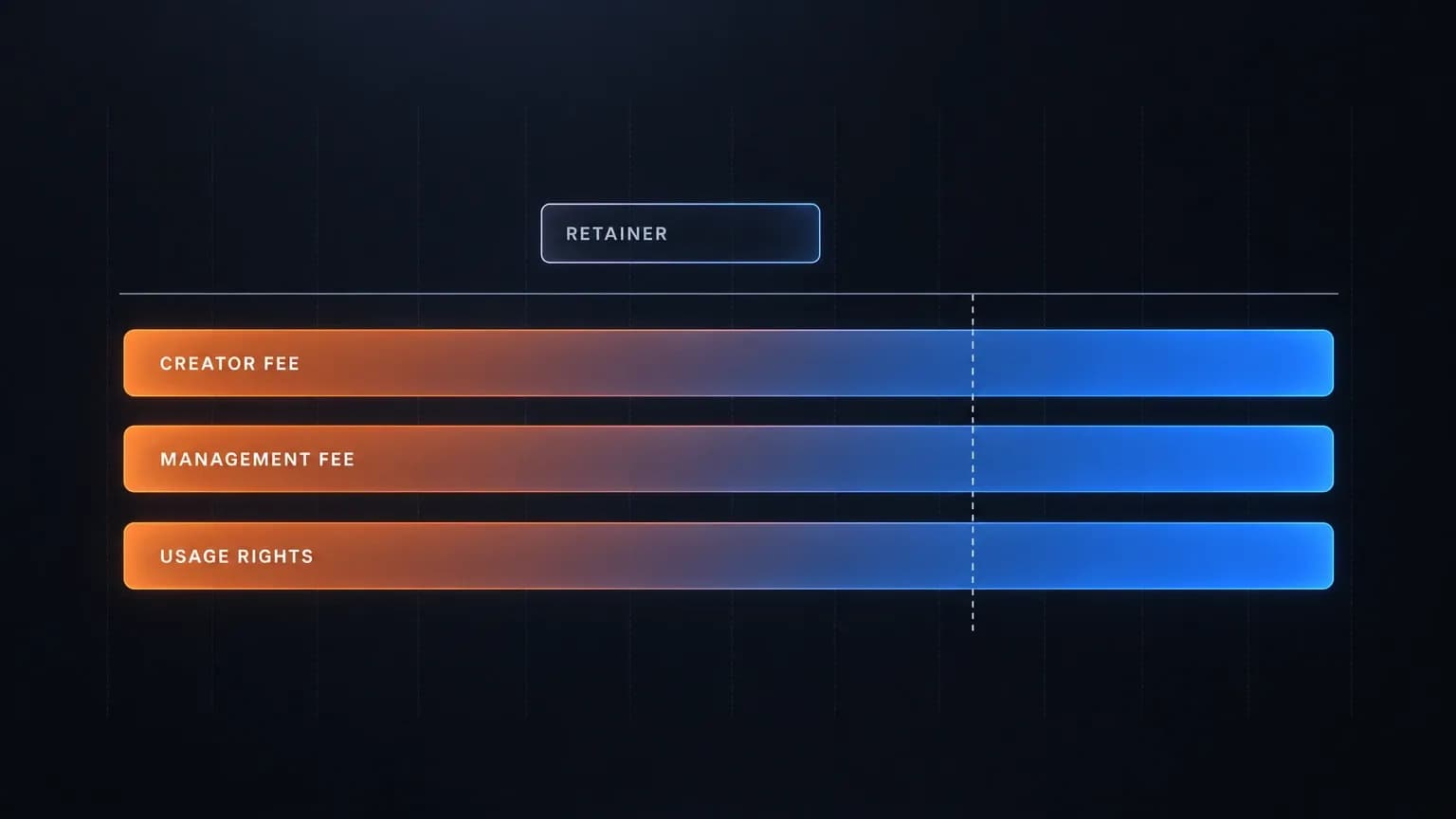
Three invoices sit behind last quarter's campaign, and only one was the number you compared across proposals. The retainer covers agency hours, not creators, and it is the smallest of the three. Which one did your finance team see first?
There were three invoices behind the campaign you approved last quarter, and only one of them was the number you compared across influencer marketing agency proposals. The other two carried a different sender. The money that reaches the creators moves through an account most marketing teams do not control, and the premium for the right to keep running the ad you already paid to make goes to a different party again. The retainer page still shows a single number, and it is the smallest of the three. Which one did your finance team see first?
What the Influencer Marketing Agency Retainer Actually Pays For (and What It Never Does)
A retainer buys agency labour: someone to build the creator shortlist, vet each name against your brand, write the brief, sit in the negotiation, chase the drafts, file the usage paperwork and send the monthly report. That is genuine work, and it is what influencer marketing services are priced to cover.
What it does not cover is the reason you started the conversation.
The proposal lists deliverables, timelines and a monthly fee. It rarely lists what sits outside that fee and still lands on your budget: the creator fee, product and shipping, media spend behind paid amplification, the usage-rights premium, exclusivity add-ons, whitelisting setup, legal review and production. Those lines are not hidden dishonestly. They are absent, and absence reads like inclusion when you compare three documents in one afternoon.
This matters more in 2026 than it did two years ago. Linqia's 2026 State of Influencer Marketing found 49% of marketers working with specialist influencer agencies, 100% repurposing creator content beyond the creator's own feed, and 81% saying that repurposed content outperforms brand-created assets. Aspire's 2026 report puts paid-ad reuse at 77%, with 67% of brands baking usage rights into the creator's initial contract. The work moved toward reuse. The invoices did not catch up.
Creator discovery also increasingly runs through an influencer marketing platform rather than a spreadsheet, and that tooling looks nothing like the SEO tools your team already knows. It is a different purchase with a different buyer, which is why it gets attached to the retainer without ever being quoted as its own line.
The other line the retainer rarely carries is measurement. Influencer Marketing Hub's benchmark report, published in March 2026, found 87.49% of brands expecting budget increases and only 10.56% of marketers using no AI at all in their influencer programs. That adoption landed on creator discovery (36.67%), content generation (21.11%) and brief development (13.89%), then thinned to 10.56% for reporting and 7.22% for fraud detection. The tools went where the risk was low. Reporting is the one job that tells you whether the spend worked, which is usually why the report you receive is a screenshot deck rather than a measurement.
Creator Fees, Management Fee and Usage Rights: Three Separate Bills
Three invoices, three owners, three renewal dates. In most channels you approve one number. Here you approve three, and only one is the retainer you compared.

Bill one: the creator fee. What the creator charges for the deliverable, paid to them and not to the agency. Collabstr's 2026 marketplace report, covering more than 200,000 creators, found nearly 80% of collaborations costing under $300, with an average asking price of $214 on Instagram. The source's own caveat is the useful part: that is a creator fee only, excluding usage rights, exclusivity, product and shipping, paid amplification and the cost of running a campaign.
Bill two: the management fee. The agency's margin, quoted as a flat retainer or as a percentage of creator spend. Published 2026 retainer ranges run from $3,000 to $30,000 a month (influencerfee.com cost guide) and $3,000 to $25,000 (sponsorships.ai), while percentage models are quoted at 15% to 30% of creator spend by both and at 15% to 25% by ainfluencer. Those figures measure different populations, and averaging them describes nobody. The shape matters more: on a percentage model, every dollar you add to the creator budget raises this bill too.
Bill three: usage rights. The premium for the right to keep using the content, and the one that surprises people. Creators own what they produce by default, even when you paid for it, and without explicit contractual language you cannot legally repurpose it in paid ads, email or on your website (Stackmatix, 2026). Gigapay's 2026 benchmarks put standard paid usage rights at 15% to 30% of the base fee per 30-day window, whitelisting at 25% to 50%, and a perpetual buyout at 150% to 300%. Its budgeting rule: hold 30% to 50% of the creator line for rights at nano and micro level, and 60% to 75% at macro.
For scale, eMarketer expects US brands alone to spend $9.29 billion on influencer marketing in 2026. A meaningful share of that lands in bill three, and bill three is the one your retainer does not touch.
Reading a Proposal Without Getting Fooled
The best influencer marketing agency proposals are the ones that tell you what they will not do.
The exclusion list
Every proposal should carry one. If it does not, the exclusions still exist, they are just yours to fund later. Write down what is missing from the fee section: creator fees, product and shipping, paid amplification media, the usage-rights premium, exclusivity, whitelisting or Spark Ads setup, legal review, production and any marketplace commission. Then price each one before you sign.
The usage window
Find the number of days. Thirty days is the common starting point in the benchmarks above, and perpetual is a different product at a different price. Then ask three questions. Which channels does the window cover? Can you edit or crop the content? And what happens when the window expires while the ad is still running? That last one is the influencer-specific trap, and nobody catches it until a campaign is performing and the rights behind it have quietly lapsed.
The performance clause, and whether it exists
Most retainers pay for effort, and the proposal says so in the language of monthly deliverables. If it promises performance, ask what happens when it misses: a fee credit, a rolled-over period, a replacement creator, or nothing. Nine times out of ten it is nothing, which is not a scandal, it is just worth knowing. Linqia's 2026 respondents explain why performance language is rare: 79% struggle to measure influencer ROI and 48% name attribution as the biggest gap. Nobody writes a performance clause against a number they cannot define.
What the Retainer Covers at Each Scope, and What It Never Covers
Scope moves the line between what you pay for once and what you keep paying for. Read the table as a scope map: which line items enter the retainer as the program widens, which stay outside at every stage, and what the widening costs you in administration.

Stage of scope | What enters the retainer | What still sits outside it |
|---|---|---|
One platform, a pilot of 5 to 10 creators | Sourcing, vetting, briefs, scheduling, one wrap report | Creator fees, product and shipping, any usage rights beyond organic reposting |
Two or three platforms, always on | Multi-platform casting, contract paperwork, rights tracking, monthly reporting | The rights premium itself, paid amplification budget, whitelisting fees |
Always on plus paid amplification | Campaign management on top of casting, cutdowns of creator content for ads | Media spend, whitelisting or Spark Ads setup, extension fees when a window rolls over |
Multi-market and multi-language | Market-specific casting, coordination of local legal review | Translation and market adaptation, separate per-market usage windows, per-market exclusivity |
Creator fees, which are not the retainer
On a percentage model the management fee is calculated on the creator spend, so the two grow together. Cut your creator budget to save money and you cut the agency's output at the same time; the pilot gets thin rather than cheap. Scope the fee base first, then the percentage. It is the same discipline you apply to PPC management services, where nobody expects the agency fee to fund the ad spend. Influencer work adds a third line on top, and the third line is the one that gets missed.
Production and usage rights, the two lines that bill separately
For UGC-style work the creator owns production and delivers a finished asset, which the agency coordinates but does not fund. A studio shoot, a script or an edit is a separate quote. Rights bill separately again, on their own renewal calendar, and that is the line that makes influencer marketing agency pricing impossible to compare across proposals. Track all three in one place: three contracts, three expiry dates, and only one of them on the retainer page.
Agency or In-House? The Honest Split
Hire the agency for the bench you cannot build in a quarter: a casting list, a history of rates, and someone who has negotiated with these creators before. An influencer agency earns its fee on that bench. Keep three things on your side of the table, because they are the whole asset.
Casting sign-off. You approve the shortlist, not the agency. That is a control question, not a trust question.
The creator pipeline. Who you worked with, what you paid, how they performed and what rights you hold. If that list lives only in the agency's project tool, your next campaign starts from zero whether or not you stay with them.
The usage-window audit. One calendar, owned by someone on your team, listing when every window opens and closes, exported monthly. In content marketing services engagements the deliverable is usually a page you own outright and the relationship is disposable at renewal, and a B2B SEO agency can hand over a content library and a link profile on the last day of the contract. An influencer agency hands over a deck, and the creator will not answer your email if the break was messy.
What to Measure in the First 90 Days
Set these up before the first creator is briefed. Half of them are not performance metrics at all, they are rights and ownership checks, which is the honest version of a first-90-days plan for this channel.
- Days 1 to 14: a rights register. Every creator, every window, its expiry date and renewal price, reported next to spend as one of your marketing KPIs, not filed in a legal folder.
- Days 1 to 30: casting quality. Shortlist accept rate, reply rate, and how many creators pushed back on your rates.
- Days 15 to 45: the ratio of rights premium to base creator fee. Above the benchmarks you were quoted means the scope was written too narrow.
- Days 30 to 60: reuse volume. How many assets reached paid, email or your site, against the 77% of brands doing this (Aspire, 2026).
- Days 45 to 90: one attribution measure, chosen in advance. No pick by day 45 means you are in the 48% with a gap (Linqia, 2026).
- Days 60 to 90: creator retention. How many came back for a second campaign, and at what rate. It is the only number an agency cannot fake with a bigger cast.
- Every month: the expiry audit. A window that lapses while a winning ad runs costs more than any fee on the retainer.
The cadence is not exotic, it is the discipline you would hold a startup marketing agency to, with two entries that only exist here: the rights register and the expiry audit.
Conclusion
The retainer is one line of three, and the proposal is built so it is the one you notice. Creator fee, management fee and usage rights are separate invoices with separate owners, and the useful work is knowing which is which before anyone is briefed. If you keep the pipeline in-house and need the measuring and reporting layer, that is a smaller purchase than a retainer: Allable.ai runs at EUR 99, EUR 199 and EUR 399 a month for its three tiers, each starting with a 7-day trial that requires a card. Either way, take one question into your next conversation with an influencer marketing agency. Which of the three bills did you think you were approving?
FAQ
How much does an influencer marketing agency cost?
Three numbers from three places. A management fee, quoted as a retainer or a percentage of creator spend, sits at the published ranges above, and it is the only part the retainer covers. Then the creator fees, which the agency does not pay. Then the usage-rights premium, which most proposals omit and which can run from 15% to 300% of a base creator fee depending on the window and exclusivity you ask for (Gigapay, 2026). Searches for influencer marketing agency pricing and cost mostly return rate cards and forum threads, and those answer the smallest of the three questions.
Do I pay creators separately?
Yes, in almost every structure. Some agencies pay creators and rebill you, some run the payment through their own account and add the fee on top, and some pass the invoice through untouched. All three are normal. What matters is which account the money leaves and who holds the creator contract, because that decides who can renegotiate next time and who keeps the rights when the engagement ends.
When is an influencer agency not worth it?
When you have one channel, a handful of repeat creators and no legal complexity, you are buying coordination you can run yourself with a spreadsheet and a decent brief. It is also the wrong purchase if what you need is content for ads rather than creator distribution, because that is a UGC sourcing job with a different price shape. And skip it while nobody on your side can name the one number the program should move, because an agency with nothing to be measured against will still send a report every month.