Marketing Plan Template: The Version That Survives Contact With a Quarter
 Written by Martin J.
The plan you approved in January was correct on the day you signed it. When the paid search line breaks next Tuesday, who on your team is supposed to say so out loud?
You know this plan. It was solid on the day you signed it and you have not opened it since. Nobody on your team was ever given the job of noticing when one of its numbers stopped being true. So the plan you approved in January is now a record of one afternoon's beliefs, and at least one of its lines is already wrong. Where would you even look to find out which one?
Ask the search box what a marketing plan template should contain and it will hand you a flawless section list, drawn from two of the biggest names in marketing software. You can have that list in thirty seconds. It will not tell you whose name goes next to the paid search line, what that line quietly assumes, or what number would make you move twelve thousand dollars out of a reserve. A plan whose lines carry no owner and no threshold does not get revised. It gets abandoned around week six while the budget keeps running on the original mix.
What the Most-Cited Marketing Plan Templates Assume
Look at what actually ranks for this query and the field is thin in a specific way. A Forbes contributor post from September 2013 still holds a head position, which tells you how little pressure this result has felt. Beside it sits a gated lead magnet instead of an editorial answer, a Reddit thread where marketers ask each other what the field never explains, two PDF downloads, and a row of vendor template galleries. One brand holds two positions here: an editorial post that is genuinely useful, and an offers subdomain that is a form gate.
The section list they all publish is identical. Executive summary. Brand positioning and unique selling proposition. Target audience and buyer personas. Competitive analysis. Then goals, budget and metrics. The AI Overview and the AI Mode panel both reproduce that list at length, and both call a template plug and play. So the components of a marketing plan are not in dispute and the structure is table stakes. Search for marketing plan template examples and you will find hundreds of pages built on that list, most stopping the moment it is complete.

Here is what none of them does. One page states that objectives and KPIs may need to shift mid-year, and it states it as permission rather than as procedure: no owner, no evidence, no deadline. Four pages mention owners somewhere, and not one requires a single accountable owner per line or names an owner for the plan document. No page asks you to write down the assumption a line rests on. No page sets a threshold that reopens a line. No page keeps a change log either: the only last-edited notes sit on the articles, not on the plans they prescribe. Half the field finishes at leadership approval, which is where the revision problem starts.
The field also muddles one distinction. A marketing plan is not a go to market plan: that one is the pre-launch instrument, covering market, price, channel and motion for something that does not exist yet. The marketing plan is what you run afterwards, quarter over quarter.
Planning for the Revision, Not the Kickoff
The difference between a plan and a plan that keeps working is three fields per line. Every line is a bet: a number, a date, and an unstated belief about the world that makes the number reachable. Write the belief down, attach a name to the line, and decide in advance what evidence would make you reopen it. A line carrying all three can be re-cut in twenty minutes. A line carrying none has to be argued from first principles in a meeting, which is why it never gets argued at all.

One Owner per Line
The test comes from ordinary RACI discipline: if you cannot name one Accountable owner, that is a red flag. One name, not a department, not a channel name, not the team. If a line belongs to two people, it belongs to nobody, because each can reasonably assume the other is watching it.
The evidence for treating this as structural is uncomfortable. Wellingtone's State of Project Management 2026, a survey fielded across more than 150 organizations, found that only 36% of organizations mostly or always complete projects on time, 49% on budget, and just 42% deliver the full benefits. In the same study, only 55% of PMOs have clearly defined roles and responsibilities, and its own reading is that maturity starts with clear ownership and visible status, which is where deadlines slip.
Your operation already applies this rule where it works. A content brief template is one brief, one writer, one owner. Apply it to a budget line and the plan stops being an orphan document.
One Stated Assumption per Line
Write the bet next to the number. A target of $41 cost per acquisition for new paid customers is really a claim that branded search keeps absorbing most paid clicks at under $10, or that no competitor enters the two head terms this quarter. Until that claim sits in the cell, the number is untestable, and a number nobody can test is a number nobody can defend.
The money attached to that habit is the argument for it. Improvado's Marketing Budget Allocation Guide 2026, a vendor analysis of roughly $480M in marketing spend across 150 enterprises, reports that top-quartile return performers allocate 18% of budget to reserve funds for mid-year reallocation, against 3% for the bottom quartile. Read that as a price tag: plans that expect to be revised hold six times the reserve of plans that do not. Gartner's 2026 CMO Spend Survey, relayed with a named source, puts total budgets at 7.7% of company revenue, the lowest in a decade.
The revision is the normal case, not the exception. Clutch's budget survey, published in December 2025, found that 85% of marketers expect budget adjustments as priorities shift, and 48% plan to move more than half of their budget into digital channels. Build for that and you plan for the median outcome.
One Review Trigger per Line
A date is not a trigger. Every page in the field that mentions review means a calendar entry, and a calendar entry tells you when to look, never what would make you change something. A trigger has a condition, a threshold, and the decision already attached: if blended paid cost per acquisition sits above $55 for two consecutive weeks, $12,000 moves out of the reserve and into the channel that is converting.
This is the part I care about most in my own work, and it is why I built Allable around connected accounts rather than around documents. Marketing planning software will hold the columns for you and it will not fill a single one in, and it cannot tell you which assumption just broke. What a plan needs is the ability to ask "compare this week's cost per acquisition against line one and tell me if the threshold broke" and get the answer from the live account. That is the difference between a plan that gets revised and one that gets rewritten every January. Allable plans run at EUR 99 per month (Pro), EUR 199 (Business) and EUR 399 (Scale), each starting with a 7-day trial. The value is not the table you fill in, it is the loop that reads it back.
The Marketing Plan Template: Five Columns, No Empty Cells
Here is the structure, built for the second reading rather than the first. Every row is a plan-level commitment: a channel, a budget, a target.
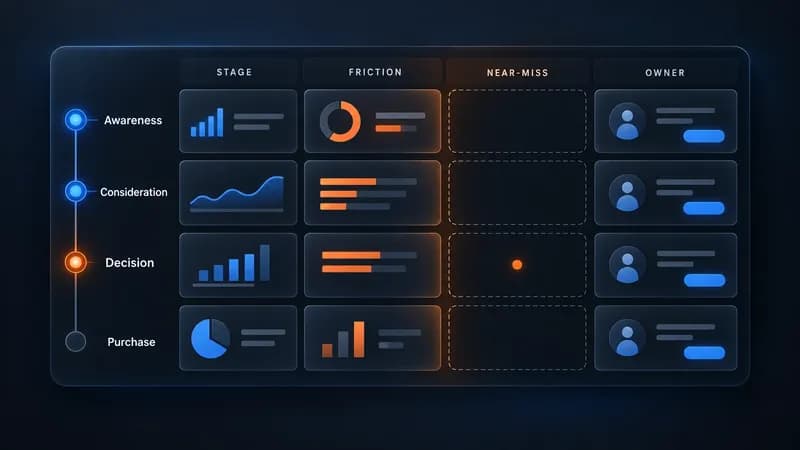
Line the plan commits to | Number and date | Owner | The assumption under the number | Reopen if |
|---|---|---|---|---|
Paid search: new customer cost per acquisition | $41 by week 6 | Maya K., paid lead | Branded search keeps absorbing most paid clicks at under $10 | Blended paid cost per acquisition above $55 for two straight weeks |
Organic sessions to commercial pages | +22% quarter on quarter by week 12 | Tomas, SEO lead | The pages that already rank hold their positions all quarter | Commercial page sessions flat or down two weeks in a row |
Budget reserve held unallocated | 18% of the quarter, $37,800 | Maya K., paid lead | At least one channel needs a re-cut before week 8 | Reserve still untouched at the week 6 checkpoint |
Partner and webinar pipeline | 40 qualified conversations | Peter, partnerships | Average partner referred deal size holds at $3,100 | Conversations below 20 at week 8 |
Total quarter budget | $210,000 including the reserve | Head of marketing | The revenue plan holds, so the budget is not cut mid-quarter | Finance signals a hiring or spend freeze |
Three rules keep the table honest. No cell says TBD, because an unfilled cell is a line nobody has thought through. A line without a name in the owner column does not get funded, which is the RACI test applied to money. And the assumption column gets filled before the budget is approved, not after the first result arrives.
This is where the sample marketing plan template stops, at the blank cell, handed over as a promise that filling it will be the hard part. Filling it is the easy part. Three of these five columns exist to be used in month two.
A Worked Quarter: A Sample Marketing Plan Template Being Re-Cut
A quarterly re-cut is not a new go to market marketing plan and not a second budget round. It is four decisions against four lines, each traceable to the assumption written in the cell.
Week | What the data showed | Line it hit | Assumption that broke | Decision taken |
|---|---|---|---|---|
2 | Paid cost per acquisition moved from $38 to $52 after a competitor entered the two head terms | Paid search | Branded search keeps absorbing clicks at under $10 | Moved $12,000 out of the reserve into paid search and paused the display test |
4 | Webinar registrations at 9 against a plan pace of 30 | Partner and webinar pipeline | The partner's list overlaps our audience enough to fill sessions | Held the line to week 8 against its threshold instead of cutting it early |
7 | Commercial page sessions up 14% against a plan pace of 22% | Organic sessions | The pages that already rank hold their positions | Reset the quarter's target to +9% and handed the gap to paid search, with no rewrite of the document |
11 | Reserve still untouched at $37,800, which is 18% of the quarter | Budget reserve | At least one channel needs a re-cut before week 8 | Deployed half into the converting channel and committed the rest to reducing next quarter's top-up |
Four rows, and nothing in the high-level structure changed. Same summary, same positioning, same goals. What changed was four lines, each because a named assumption stopped being true and a threshold had already been agreed.

The one thing this section deliberately does not touch is content freshness. Refresh cadences, decay windows and repurposing pipelines are a different job on a different document, and the sibling that owns it is our content calendar template. The revision here is the quarterly revision of the plan itself: the line, its owner, its assumption, its trigger.
What to Track Weekly Versus Quarterly
The split matters more than the metric list, because tracking the wrong thing weekly is how teams react to noise and miss a real break.
Weekly, per line: the cost per acquisition or cost per conversation against the number in the plan, spend against planned spend, and pipeline conversations. Four numbers per line is plenty. If a threshold in the reopen column has been crossed, the decision was written in advance and takes one message.
Quarterly, and only quarterly: the assumptions themselves, contribution per channel, unit economics, and the reserve. Judging a brand awareness investment weekly tells you it is failing every week. Judging an acquisition cost only at quarter end tells you eight weeks late.
Two failure modes are worth naming. Weekly reviews of lagging indicators create churn that looks like management. Quarterly-only reviews of leading indicators produce a January document nobody consults until April.
Your scorecard needs a home and an owner, which is the same ownership rule applied one level up. That person is a real cost line, which is part of why teams price the marketing analyst salary range before posting the role. For the measurement that belongs in the plan rather than in a slide, the marketing KPIs cluster is our reference, and the SEO report template is the working surface for the organic line.
Frequently Asked Questions
What should a marketing plan template include?
The standard sections, which the search engines publish above every result anyway: an executive summary, brand positioning and unique selling proposition, target audience and buyer personas, a competitive analysis, then goals, budget and metrics. What separates a usable template from a decorative one is what it adds after that list. At minimum, three extra fields per line: one accountable owner, the assumption the number depends on, and the condition that reopens the line. Without those three, a plan records decisions but cannot revise them.
What should the contents of a marketing plan actually list?
The standard marketing plan contents is a list of chapters, and on its own it tells you nothing about whether the plan will survive a moving quarter. Contents that work in month two name the plan-level lines instead of the chapters: paid search acquisition cost, organic sessions to commercial pages, the budget reserve, the pipeline target. Each line carries its number, its owner, its assumption and its trigger. If you cannot tell whose Tuesday changes when a number breaks, the contents are decorative.
How long should a marketing plan be?
As long as the lines require and not one page longer. For a typical team that is four to eight pages: the section list on one page, the line table underneath it, and the thresholds attached to those lines. Length is not what holds the weak pages in this field near the top of the results. The longest page running carries the same omissions as the shortest one.
What is the difference between a marketing plan and a content strategy?
A content strategy is one line of the plan expanded into its own discipline, with its own calendar, production rules and freshness cycle. The plan holds the channel targets, the budget and the thresholds across everything. Keep the boundary clean: the plan decides how much the organic channel gets, the content strategy decides what gets made with it. When the two describe the same things, you have two documents that contradict each other by week six.
The Last Twenty Minutes of the Quarter
The next plan you write will be approved, distributed, and then left alone for eleven weeks, unless the document itself gives someone a reason to open it. Give every line a name, a written assumption and a threshold, and the revision stops depending on anyone's memory.
So before you fill in a single number, do the cheap thing first. Name the owner of every line and write down what each one assumes. A line with no name against it is the line that will be wrong in April, and unowned when it matters.