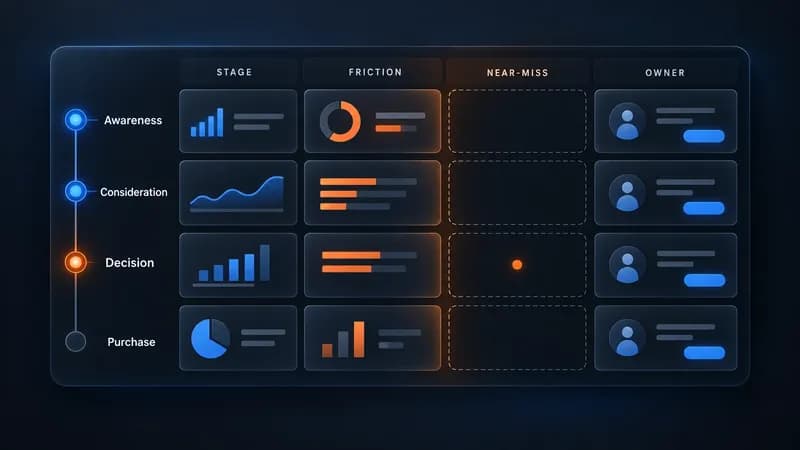
Go-to-Market Strategy Template: The One Page Every Launch Actually Needs
 Written by Team AllAble
A template you cannot finish is worse than no template, because it looks like a plan. Yours probably stops at the section that asks who the first buyer is. Does it have an answer, or a blank you have learned to skip?
The file you downloaded last quarter is still three sections short. Not because you ran out of time, but because two of the blanks had no obvious answer, and the launch went ahead without them. Every go-to-market strategy template you can download hands you those blanks and nothing to put in them, so the file stays open and the quarter starts anyway. That is the pattern behind launches that stall in month two: the page gets written up to the point where it asks a hard question, and the team moves on to tactics instead. CB Insights studied 101 failed startups and found that 42% died from no market need while 35% could not reach customers. Neither of those is a product problem. Both are the blanks you skipped. Your version is probably sitting in the same state right now, which means your next launch is already carrying the same gap, and the only thing that has changed is the deadline.
Why Most GTM Templates Fail Before the First Draft
The template is rarely your problem. Look at what actually ranks for this term and the pattern is hard to miss. Asana's template page wants a signup before it shows you anything. Canva trades a pack of design files for your email address. Mural keeps its canvas behind a login, Smartsheet puts six files behind a form, and Notion's collection of GTM templates lives inside its marketplace. Zendesk publishes the strongest section table in the field and still hides the template behind a download form. Reforge shows real examples to members only. Every one of those pages owns the format and then hands it to you empty.
Notice two more things while you are comparing them. Smartsheet's page is dated October 2022, and Canva's title still advertises 2025 examples, in a field you are reading in October 2026. Freshness alone will not win you the query, but it tells you how much attention the incumbents are paying.
So you are not short of frames. You are short of a frame with answers in it, and a rule for knowing when it is finished. That is the first failure: comprehensiveness. List fourteen sections and a team of five will stall around section five, because nothing on the page tells them which five matter. The second failure is ownership. Asana's own guide says each phase should be tied to specific goals and owners, and then never assigns a single one. You end up with a page everyone agreed to and nobody owns, which is the same as having no page at all.
Both failures come from the same place. The go to market strategy templates you find online are built to look complete in a screenshot, not to be finished by a person. Your launch needs the opposite: fewer sections, a name next to each one, and a test for done.
The Go-to-Market Page, Section by Section
Here is the whole page, filled in for one product so you can see how a finished version reads. Five sections, six owners, one quarter. This is the go-to-market framework the rest of the field describes and never fills in, and everything here is short enough to defend in a meeting and specific enough that a competitor could not paste it into their own deck.

```
GO-TO-MARKET PAGE: approvals layer for marketing assets
Product: one workspace where campaign assets get reviewed, commented on and approved
Launch window: Q1, one product, one market (US, English)
- TARGET SEGMENT
In-house marketing teams of 10 to 50 people at B2B software companies who ship
more than 40 assets a month and have no full-time operations hire.
One sentence: "We sell to the person who chases approvals by email."
Owner: marketing operations lead - POSITIONING
For content operations leads drowning in approval threads, this is the approval
layer that lives inside the tools the team already opens every morning, so nobody
has to learn a second system just to sign something off.
Not for: agencies managing client work.
Owner: marketing lead - PRICING AND THE ASSUMPTION UNDER IT
$18 per seat per month, billed annually.
This assumes the team already pays for a digital asset manager and will pay again
for approvals. If that assumption is wrong, the price drops and the channel changes.
Owner: marketing lead with finance - CHANNEL ORDER
First: the integration directory of the two asset managers our segment already runs.
Second: outbound to content operations leads.
Third: paid search.
Only the first gets budget at launch. The other two wait until the first shows a
repeatable cost per activated team.
Owner: marketing lead - LAUNCH METRICS, NAMED BEFORE THE WORK STARTS
Time to first approved asset (target: under 20 minutes).
Share of assets approved without an email thread (target: 60% by week 8).
Activated teams (target: 12 by the end of the quarter).
Owner: marketing lead
THE TWO SECTIONS THAT DECIDE IT
First buyer: the content operations lead, not the CMO. She has the pain this week
and the budget this quarter.
What has to be true for her to switch: her first asset review has to happen inside
a tool her team already had open this morning.
If either answer is missing, the page is not finished.
```
Target segment and the one sentence that defines it
A segment is not a market size, it is a person. Write the buyer as a role inside a company of a known size, doing a job you can describe in one line. The test I use is whether the sentence survives a competitor reading it: if they could write the same sentence about their own product, you have written a category description, not a segment. "In-house marketing teams of 10 to 50 people who ship more than 40 assets a month" passes, because it excludes both the agency down the street and the enterprise with a dedicated operations department. "Marketing teams who want to work faster" fails, because every vendor would sign it. One sentence, one owner, and the owner is the person who would notice your segment drifting.
Positioning statement, written so a competitor could not copy it
Two sentences and a refusal. The first names who it is for and what changes for them. The second names what sits next to it in their day, which is usually the tool they already pay for. Then the refusal: who this is not for. The refusal is what makes the statement hard to copy, because it costs something to write. A competitor can match your benefit claim in a minute. They cannot match a boundary that excludes part of their own pipeline. Keep both sentences under 25 words, and if one needs a semicolon to survive, you have not decided yet.
Pricing and packaging, with the assumption stated
Write the number and the assumption it rests on. The number alone tells your team nothing. The assumption tells them what to watch. In the example above, $18 per seat rests on the belief that the team already pays for a digital asset manager and will pay again for approvals. If that belief is wrong, the price moves and the channel moves with it. Nearly every template in this field names pricing as a section and shows you nothing to put in it. Yours should carry three lines: the price, the package it applies to, and the sentence starting with "this assumes". State the assumption even when you are unsure, because an assumption you wrote down is one you can test, and a price without one is a guess with a spreadsheet underneath it.
Channel order, and why only the first channel matters at launch
List every channel you might use, then number them. Only the first gets budget, and the rest wait until it produces a repeatable activation cost. Two channels at launch means two half-built motions, and you will not be able to tell which one is working. Picking the first is easier than it looks: choose the one where your buyer already spends an hour a day. For the example above that is the integration directory inside the asset manager its segment already runs. Your answer depends on the martech stack your buyer lives in, because a channel that ignores their existing tools asks them to change habits before they have seen a single result.
Launch metrics, named before the work starts
Three numbers, written before launch and owned by one person. They have to be readable inside the quarter, or they are history rather than feedback. The most useful pair is a time-to-value number and a behavioural one. Time to first approved asset is the first. Share of assets approved without an email thread is the second, because it measures whether the product replaced the habit it promised to replace. Activated teams is the third, and it is the one your board will ask about. Measure that last one against the population that could have adopted it, not against every seat you sold: adoption can look healthy while the complaint volume on the original problem stays exactly flat, and that means a feature got clicked rather than a problem got solved. If you are still choosing between candidate numbers, the selection logic lives in marketing KPIs. What matters here is narrower: the numbers exist before anyone starts work, and each one has a target and a name beside it.
The Two Sections That Decide Whether the Launch Works
Every section above can be imperfect and your quarter can still be recovered. These two cannot, and you need them written before anything else on the page.

Who is the first buyer. A person with the problem this week and the budget this quarter, named by you without hedging. Not "our ICP". Not "marketing leaders". A role, a company size, and the reason they are shopping now. If you cannot write that sentence, you do not yet have a launch, you have a product and a hope.
What has to be true for them to switch. This is the harder question, because switching is paid in habit rather than dollars. The a16z enterprise survey found that 70 percent of buyers named speed of deployment as a top factor when engaging AI vendors, which is why the honest answer here is usually a time-to-first-value number rather than a feature list. If your answer is "we are better", you have not answered the question. You have restated your positioning.
CB Insights puts 35% of startup failures down to an inability to reach customers, and that failure looks like this: a segment, a price and a channel, with nobody named who would change what they do in order to buy. Asana's guide tells you phases should be tied to owners and then leaves the field blank in exactly this spot. Fill it or the page is decoration.
Those two lines are also what keeps the page alive after launch. GTM engineering is the practice of turning your launch page into something your team revisits every quarter, and it starts from these two answers rather than from the deck.
A Worked Example (One Product, One Quarter)
Same product, same quarter. Here is what your page said before launch, and what the quarter actually showed.
Section | What we wrote before launch | Owner | What the quarter showed |
|---|---|---|---|
Target segment | In-house teams of 10 to 50 shipping 40+ assets a month | Marketing operations lead | Held. Two inbound deals came from 200-person teams with an operations hire and both churned on price. |
Positioning | Approval layer inside the tools the team already opens | Marketing lead | Held, with one change. Buyers repeated "inside our existing boards" back to us more often than they repeated the approval promise. |
Pricing assumption | $18 per seat, assuming a separate budget for approvals | Marketing lead with finance | Broke. Approvals were funded from the asset manager line, so the price landed at $9 with a bundle conversation. |
Channel order | Directory first, outbound second, paid search third | Marketing lead | Held. The directory produced 9 of the 12 activated teams. Outbound started two weeks late and produced none. |
Launch metrics | 20 minutes to first approved asset, 60% without a thread, 12 activated teams | Marketing lead | Missed once then held. Time to first asset landed at 34 minutes and needed an onboarding fix. |
First buyer | Content operations lead | Marketing lead | Held. The strongest deals came from this role, and the weakest from CMOs who delegated to nobody. |
Switch condition | First review happens in a tool already open | Marketing lead | Held and narrowed. Reviews had to happen in the board the team already used, not merely in a browser tab. |
Read the table backwards if you want the useful lesson. Two rows held without change, two held with a modification, and one broke outright. The one that broke was the assumption under your price, which is the section every template in this field leaves empty.
Three conditions tell you the page is finished, and none of them depend on the word count:
- Every section has a name beside it, and no name appears on more than three sections.
- The pricing line carries an assumption you could be wrong about.
- You can name the first buyer and the switch condition out loud, without looking at the page.
Miss any one of those and you have a document, not a plan.
What to Cut When the Team Is Two People
Most of the published guidance assumes a launch team. With two people, your page survives only if you delete as much as you keep.
Cut the competitor teardown down to three named rivals, and only the three your buyer is actually evaluating. The persona set drops to one segment, because running two segments with two people means running half of each. Drop the second and third channel from the budget and keep them as a note, since the whole point of channel order is that only the first one gets funded. Revenue modelling and the board narrative can go too, because they belong to finance and to your next fundraise rather than to a launch page. What you keep is five short sections, three metrics, and the two decision answers, filled in one afternoon.
Where the first channel genuinely needs more hands than you have, content marketing services exist for exactly that reason: one channel, executed properly, instead of five channels described in a plan nobody finishes. The same logic applies to every other column in your plan. Buy capacity on the one motion that has to work this quarter, and leave the rest on paper where it belongs.
Make the Page Before the Pitch, Not After
A go-to-market strategy template is worth exactly as much as the answers you put in it. Five sections, an owner per section, one stated assumption under the price, one funded channel, three metrics with targets, and two questions answered in a single sentence each. That is the whole deliverable, and it takes an afternoon rather than a quarter.
What changes when you work that way is not the launch itself, it is how fast you find out that a launch is not working. The pricing assumption breaks in week three instead of at renewal. The channel that produced nothing shows up as nine activated teams from the directory and none from outbound. You get the correction while you can still act on it, which is the only thing a plan was ever for.
If your team already runs campaigns and reporting in one workspace, this page gets easier to keep alive, because the numbers you named are the numbers you can read without exporting anything. If it does not, run the page anyway. Write the two answers first, and notice how much shorter the rest of the document becomes.
Start with the question you have been avoiding: who is the first buyer, and what has to be true for them to switch?
Frequently Asked Questions
What should a go-to-market strategy template include?
Five sections and two decision lines, each with an owner: target segment in one sentence, positioning with a refusal, price with a stated assumption, channel order with only the first channel funded, and three launch metrics named before work starts. Then first buyer and switch condition, which are the two that decide the launch. Compare that with the checklist most AI answers give you, which runs to fourteen sections and names no owner, no order of priority, and no way to tell when the page is done.
How long should a go-to-market plan be?
One page, five sections, one afternoon. The pages ranking for this term run between roughly 1,200 and 3,500 words of surrounding prose, and every one of them asks you to download a file that is longer than the page you need. Length is not your constraint. Completion is. A page you can finish in an afternoon gets finished, defended, and updated next quarter. A twenty-tab plan gets opened once.
Is a GTM template different from a marketing plan template?
Yes, and the difference is scope. A go-to-market page covers one product entering one market in one quarter, and it ends. A marketing plan covers the ongoing programme across a year, with budgets, channels and reporting cadence that outlive any single launch. When someone asks for a go to market plan, they usually want the launch page, because that is the artefact a launch decision actually needs. If your question is which numbers those two documents share, the answer is fewer than you think: the launch page keeps three, and the annual plan carries the rest.