Every cold email template you have copied was measured on strangers. A list that opted in plays by different rules, with different consent, cadence and deliverability risks. Which list are you actually writing for?
Every cold email template you have copied in the last two years was measured on strangers, and that is the only condition under which its numbers were ever true. Your list is not strangers. It is people who handed you an address on purpose, and when a sales sequence lands on them the damage does not stay in the copy: it moves into your sending reputation, where a practitioner's own test put 41% of identical sends in spam folders on infrastructure nobody had warmed. The pages competing for this phrase have no reason to warn you, since their product is the sequence and your list is not their concern. The same email that earned a 0.2% reply rate on a new domain earned 4.1% on a warmed one without a word changing, and what decides whether a cold email template gets read turns out to be almost nothing about the template.
Two Different Games Wearing the Same Name
Open the results for this query and you are reading a sales development playbook: templates built for a rep who has never met the recipient, ending in a request for fifteen minutes. Google's AI Mode panel returns three archetypes for this search, and all three close on a calendar ask, one with "Open to a quick 5-minute chat on [Day] at [Time]?"
None of that is wrong when you are prospecting. It becomes a liability the moment the same lines land on a list that opted in, because the two lists are playing different games under one name.
A cold list is strangers with no prior engagement, and in the United States you send to it under an opt-out model. A subscribed list is people who raised a hand, under a stricter consent model.
This page is about the second list. Our breakdown of the sequences that run after someone opts in covers what happens once a subscriber joins. Here the subject is the first touch, where there is no relationship to lean on. The two only meet at the unsubscribe rule.
The size effect is where this stops being a matter of definition. An analysis of 16.5 million cold emails found that campaigns sent to fewer than 50 recipients averaged a 5.8% reply rate, against 2.1% for campaigns with 500 or more. List size, not copy, moved the outcome by close to three times. The figure reached me second-hand, so treat it as directional, but its shape describes a subscribed list precisely: smaller, tighter, already carrying context.
The Templates, by Job
When the list has opted in, four jobs keep coming back, and none of them is the job a sales template was written for. Each block below names what triggers it, what changes because they opted in, and what to test first, because the copy is the last decision you should make. An AI campaign builder is where the trigger and the timing actually live.

Reactivating a lapsed subscriber
The classic mistake here is a calendar. Someone decides the first Tuesday of the quarter is a good day to email everyone who went quiet. A subscriber who stopped opening never told you when to send, so the trigger has to be behaviour, not a schedule.
Subject: Two questions before I stop emailing you >Hi [first name], you downloaded [resource] a year ago and I have not seen you open anything since spring. Is this still a problem you are working on? Reply with one line and I will either fix it or take you off the list.
What triggers it: 90 days without an open or a click. One email, one follow-up four days later, then stop. What changes because they opted in: a decision is a good outcome even when the decision is no. An unsubscribe here is someone leaving quietly instead of complaining publicly. What to test first: the segment. Start with people who opened in the last six months and never clicked.
Announcing a product change nobody asked for
Every subscription business ships a change that lands on existing subscribers as a bill, a limit or a removed feature. It is a notice, not a campaign, and it is the email almost nobody rehearses.
Subject: Your plan changes on [date]. Here is what it means for you. >Hi [first name], from [date] your plan includes [what changed] and drops [what is going]. Nothing is required from you today. If [change] affects how you use [feature], reply and I will walk you through the alternatives.
What triggers it: the change itself, with the first notice 14 days before the effective date and one reminder 48 hours out. What changes because they opted in: the message is closer to transactional than promotional, and in the EU that distinction decides which consent rule governs it. What to test first: clarity, not persuasion. Move the effective date into the first line and count replies asking what changed.
The first touch after a download
A download buys you permission to deliver the resource and one useful follow-up. It does not buy a meeting, and treating it that way is the most common way a marketing team burns a warm address.
Subject: the checklist, plus the part most people skip >Hi [first name], here is [resource] you asked for. Page 4 is the one people usually skip, and it is where the [specific outcome] comes from. One question so I can be useful: are you doing this by hand right now?
What triggers it: the download, delivered inside 15 minutes, with one follow-up 48 hours later before the person joins the ordinary nurture stream. What changes because they opted in: the consent is narrow and tied to a resource, so the ask ceiling is low. A question is affordable. A demo request is not. What to test first: whether the delivery email contains any pitch. Split delivery from the ask and watch how that message performs.
Asking for a favour, not a meeting
Some people in your list have a relationship with you and no commercial thread: they replied once, they attended something, they went quiet. Asking them for a meeting wastes a contact. Asking for one small thing often opens the door anyway.
Subject: one question, no pitch >Hi [first name], you asked about [topic] a while back and I have been rewriting our guide on it. Would you look at the outline and tell me which section is missing? Two minutes, and I will send you the finished version either way.
What triggers it: a prior interaction with no active commercial thread, reviewed monthly rather than triggered by an event. What changes because they opted in: the favour works because the relationship is real. It also means a wasted ask costs you a subscriber. What to test first: answerability. If the ask cannot be answered in one line, it is a pitch wearing a favour's clothes.
What Changes When the List Opted In
The moment a list has opted in, the legal model usually changes, and the sales playbook does not tell you which one you are in. Cold outreach to a business address in the United States generally runs on an opt-out model. A subscribed list is usually governed by something stricter.
Law | Region | Consent model | Maximum penalty | Unsubscribe window |
|---|---|---|---|---|
CAN-SPAM | United States | Opt-out | $53,088 per email | 10 business days |
GDPR | EU and EEA | Opt-in | 20 million euros or 4% of global revenue | 24 to 48 hours in practice |
CASL | Canada | Opt-in | $10 million CAD per violation | mechanism must work for 60 days |
CCPA / CPRA | California | Opt-out, with data rights | $7,998 per intentional violation | on request |
One detail the table cannot carry: a reply saying "not interested" counts as an unsubscribe even when nobody clicks a link.
Cadence and the unsubscribe signal
For a sequence built on a relationship, three to four touches after the initial email is a workable range, spaced three to five days apart, each carrying a new reason to exist. A touch with nothing new to say is the touch that generates complaints.
What a complaint costs you is why the cadence is tighter on an owned list. On a cold list it costs a stranger. On a subscribed list it costs someone who chose you, and it buys a spam signal on top. That reading is mine, not a measured result.
If you are still working out how to build and grow an email list in the first place, this is where the answer stops being about copy. And if the list lives in a platform that bills by contact, the arithmetic changes with every subscriber, which is why Klaviyo pricing matters here.
Deliverability, and why the sales playbook is a risk here
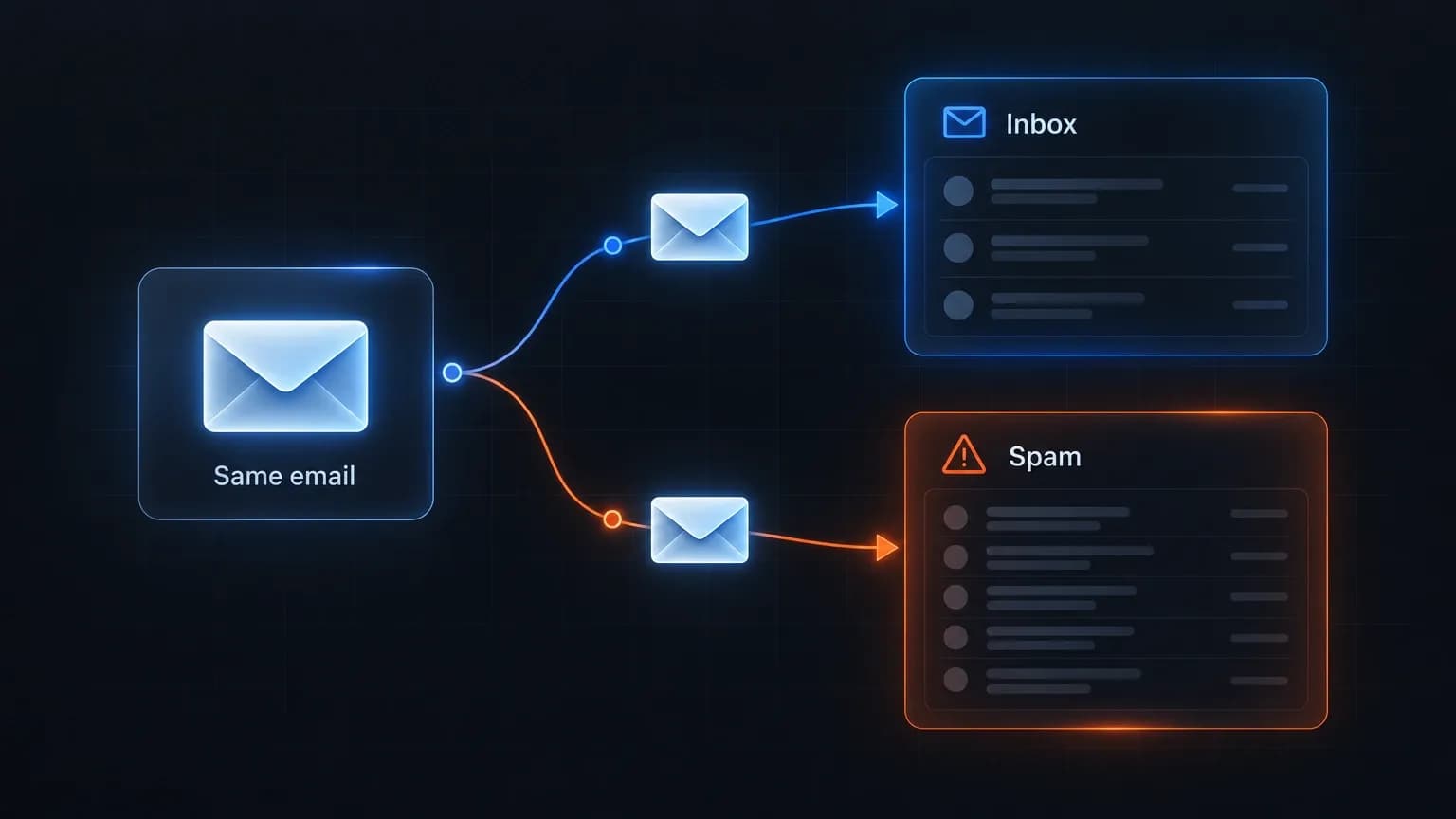
One practitioner ran three identical campaigns and changed only the sending infrastructure. On an aged domain with two years behind it, 34% of emails reached the inbox and 0.8% earned a reply, with 41% landing in spam. A brand new domain with no warm-up did worse: 12% inbox, 0.2% reply, 67% in spam. With a proper setup and a six-week warm-up: 87% inbox, 4.1% reply, 8% spam.
The identical email moved from a 0.2% to a 4.1% reply rate without a single word changing. Read that as one practitioner's three-cell comparison rather than a controlled study, because that is what it is, but the direction is unambiguous: infrastructure, not copywriting, decides whether a template is read at all.

A sending platform's own campaign case says the same thing. Ten thousand emails on one template with only the name and company swapped returned a 0.3% reply rate. Rewritten per vertical with real trigger data, the same effort returned 4.1%. That is one sender's campaign rather than a benchmark, so hold it loosely.
This is why borrowing a sales playbook is riskier on an owned list. A domain carrying your welcome emails and your subscriber base has a reputation to lose, and a run of unengaged sends is what damages it. Google's user-reported spam threshold of 0.3% is the line worth watching, though the bulk-sender rules belong with the autoresponder piece.
The Anatomy of a First Line That Gets Read
The first line of a template has one job, and it is not to be interesting. It is to prove the email was written for this person and not for a segment.
Two rules hold up. A compliment with no evidence reads as flattery, and "I love what you are building" tells the reader nothing. One specific detail beats any number of merged fields, because a merged field proves you have a database and a detail proves you looked.
"Your post on [topic] argued [specific claim], which contradicts what the rest of the field assumes" is a first line. "I noticed you work at [company]" is a mail merge wearing a sentence.
This is also where an AI writing assistant that produces variants in your own voice earns its place, because finding the first line that works means writing five and letting the list decide.
What To Test Before You Rewrite Anything
Most teams test the wording first, which is the variable that moves the outcome least. Here is the order that respects how much each item actually decides.
- The segment. Who receives it beats what it says, and the 5.8% against 2.1% spread is the proof. Split by engagement, not job title.
- The infrastructure. Measure inbox placement before replies, because a 12% inbox rate makes every copy test meaningless.
- The trigger and the timing. The same words sent 15 minutes after a download and three days later are different messages.
- The subject line. Cheap to test, and much weaker than the three items above it.
- The first line. Worth a test once the list, the setup, the timing and the subject are settled.
- The ask. Change the size of the request last, because a meeting ask aimed at a weak segment is not a copy problem.
One caution on method: the published reply-rate averages for cold outreach do not agree. One platform's benchmark report puts the channel-wide average at 3.43%, down from 5.1% in 2023, while a separate analysis of 1.37 million emails lands at 2.09%. Read the range as roughly 2% to 3.4% and then read your own numbers, because the pattern that survives every dataset is that the list decides.
If owning this in-house is not realistic, weigh email marketing agency scope against email marketing agency pricing. The review rhythm belongs to content lifecycle management, where the trigger for revisiting a piece is decay rather than a calendar.
Conclusion
The templates that get replies are not better written than the ones that do not. They are aimed at a list where the relationship already exists, which is why a sales template lifted onto an owned list performs badly and then takes your sending reputation with it. The question worth carrying into your next send is not which subject line to try. It is whether the person receiving it would recognise why it arrived.
FAQ
How long should a cold email be?
Under 80 words, in plain text, with no images and as few links as possible. That consensus holds across most 2026 sources, and it matches the templates above, which all run between 45 and 70 words.
How many follow-ups should a cold email sequence have?
Three to four touches after the initial email, spaced three to five days apart, each carrying a new reason to exist. On a subscribed list, pull that tighter, because a complaint costs you a subscriber.
Are cold email templates legal?
The templates are legal. The list decides the rules. Cold outreach to a business address in the United States generally runs on an opt-out model with a 10 business day unsubscribe window, while a list that opted in usually sits under a stricter regime, with GDPR's 24 to 48 hour window and penalties scaling to 4% of global revenue. A reply saying "not interested" is an opt-out, so route it where you route an unsubscribe click.