You have a voice document eleven people approved and nobody has opened since. That is the normal state of brand voice guidelines, and it is why the same paragraph keeps getting rewritten. So what makes the next reviewer actually apply it?
Somewhere in your drive there is a voice document with a date on it that nobody has checked in two years, and its rules are still being applied by whoever read it most recently. Your homepage, your support replies and your launch email were all written to the same standard, and none of them sound like the same company. When we went through the copy our own team had shipped over a quarter, the drift was not in the writing. It was in what each writer had been told to aim at, and that instruction is the same thing the guide was supposed to give them.
The Three-Adjective Trap
Three adjectives get unanimous agreement because they cannot be argued with. Confident. Warm. Human. Everybody nods, because everybody means something slightly different by each word, and the meeting ends with a document that has nothing in it to disagree about.

That document is written to be approved, not to be used. Ask what a reviewer does with "confident but not arrogant" when a sentence is sitting in front of them, and the answer is nothing. Both readers walk away satisfied and the sentence stays exactly as wrong as it was.
Adjectives describe a feeling about a finished text. A guideline has to decide something before the text exists.
The field has settled on this pattern anyway. The consensus definition circulating in 2026 puts a core adjective in its first clause: one idea board on this topic summarizes the whole discipline as "a core adjective, messaging pillars, audience cues, and concrete examples". Vendor explainers build their charts out of the same descriptors. It is an easy pattern to copy, which is why the guides keep getting written and keep not working.
The numbers on the other side are worth sitting with. Lucidpress and Marq's State of Brand Consistency Report surveyed more than 400 organisations for its 2019 edition and found consistent branding associated with a 33% revenue increase, up from 23% in 2016, while 81% of companies still reported dealing with off-brand content. A 2026 compilation of Marq's brand work adds the line that matters here: only about 25% of companies with brand guidelines say they enforce them consistently. Capital One Shopping Research, carried in the same compilation, puts the gap at 95% holding guidelines and 25 to 30% actively using them. Those two figures reach us second hand, so treat them as directional.
The organisation that publishes more copy than almost anyone went the other way on purpose. GOV.UK's content design guidance cuts straight against the adjective habit, warning that "adjectives can be subjective and make the text sound more emotive and like spin", and it demonstrates the alternative. Every quality it names sits on top of mechanical rules: use this word, not that one, write the date this way, do not open with this construction. There is nothing to interpret and therefore nothing to argue about at review.
What Actually Goes in the Document
A voice guide earns its place by holding four things a reviewer can act on. Everything else in the file is scenery, and scenery is how a two-page document becomes a thirty-page one that nobody opens.
Voice principles written as decisions, not adjectives
Turn each principle into a choice that binds, and state the trade it accepts. Not "we are plain and clear", but "we would rather be plain than clever, and we will cut a joke before we cut a fact". Not "we are human", but "we name the person who does the thing, and we do not hide behind the process".
The difference shows up in review. A decision can be contradicted by a sentence in front of you, which is the entire point of writing it down. An adjective cannot be contradicted by anything.
Mailchimp's content style guide does two things worth copying. It separates voice, which is constant, from tone, which shifts by context and by reader state. Then it ranks its priorities out loud: it is always more important to be clear than entertaining. That ranking is what lets a writer resolve a conflict without escalating it. GOV.UK ends up on the same three layers as Mailchimp: named values, mechanical rules under each value, and worked examples underneath. If you are building a wider brand messaging framework, this is the layer it rests on.
Keep the count low. Four principles are defensible in a review. Ten are a poster.
The do/don't pair, taken from your own copy
This is the part almost nobody writes. Two of the strongest pages in this field carry do and don't lists, and both write them as generic advice sitting beside an adjective. General advice about tone is not evidence about your brand.
Write the pair against a sentence your company actually published. Here is one from our own blog, shortened:
Before: "Allable empowers modern marketing teams to unlock content velocity at scale."
After: "Allable writes, schedules and publishes your articles. You get a finished draft and a publish date."
The rewrite encodes three decisions: name the action instead of the outcome, let a person be the subject of the sentence, and do not stack verbs until the sentence stops meaning anything. Put the pair under the principle it belongs to and a reviewer has something to compare against rather than something to feel.
One pair per principle is enough. Four real comparisons beat forty abstract examples, because a comparison carries a decision and an example carries a mood. The pair is also the only form of guidance that survives being handed to a model. arXiv study 2509.14543, from Stony Brook University, Penn State and the Bosch Center for AI, had six frontier models imitate more than 400 authors across four datasets: authorship detection stayed at 95% or better on structured text and collapsed to roughly 19% on informal blog writing. Examples work where the format does most of the work, and fail exactly where voice matters most.
Tone shifts by surface, with the boundary stated
Tone should move. What must not move is your claim.
Name the surfaces where the register changes: an error message, an invoice line, a launch post, a support reply, a sales email. Then state the boundary in the same breath, because a guide that says only "friendlier" cannot see the trade it is making. Nielsen Norman Group's tone-of-voice research surveyed more than 1,000 US adults rating organisations on five-point scales and found trustworthiness explained 52% of the variance in desirability, with friendliness adding only about eight points on top. Recasting formal bank copy as casual raised friendliness by 0.7 points and trustworthiness by 0.3. Making insurance copy playful cut trustworthiness by 0.3. Friendlier is not free.
So write brand voice and tone guidelines as two columns with a wall between them: the tone column changes by surface, and the wall holds the things that never change on any surface, including the promises you are not allowed to make and the claims that always need a number behind them.
Vocabulary: the words you retire
Not a list of industry words. A list of your own tics.
Every team has three or four words that have stopped carrying meaning through repetition: solutions, empower, unlock, world-class. Retire them explicitly, and say what replaces them. It is the cheapest part of the document to write and the fastest to apply, because a reviewer scans for a word rather than judging a sentence.
Two more categories belong here: words that over-promise on your behalf and get quoted back at you during a renewal, and words your competitor has claimed so completely that using them makes you the follower.
Writing It in One Workshop
A voice guide written by committee reads like a committee wrote it. Decisions need disagreement, and disagreement needs a room with a clock in it.
Book ninety minutes, invite five people, and run four moves. Pull ten sentences your company has already published and read them out. Mark which ones you would defend in front of a customer. Write the decision behind each one, which is where the principles come from rather than from a brainstorm. Then agree one before/after pair per principle and stop. Defining brand voice takes an afternoon. Agreeing on adjectives takes six weeks.
Who is in the room matters more than the agenda. Bring the person who writes the most, the person who complains about it the most, and one person from sales or support who hears what customers say back. That last seat keeps the document anchored to how your buyers actually talk.
If agencies and freelancers write for you, the guide has to survive the handoff. The content brief template covers how to hand work to an outside writer, and if you are choosing between content creation agencies, the voice guide is the document you will be judged against.
Enforcing It in Review
Enforcement is a second reader with three minutes and a short list. It only works if the list is short enough to actually get used.
The two-pass checklist
Two passes, three questions each, six in total. Longer than that and the list gets skimmed, which is worse than having no list.

Pass one belongs to the writer, before the draft leaves their hands. Does this sentence name an action and the person taking it? Would I say this out loud to a customer without changing it? Does every claim in it have a number behind it?
Pass two belongs to somebody who did not write the draft. Read the first line only, and ask whether you can tell which company it came from. Find the sentence the writer is most pleased with, and check whether it is doing work or showing off. Then read the call to action, and ask whether a reader knows what happens next.
Keep it as prose in the document. A checklist that lives in your head or in a project tool is not part of the guide.
Who owns the final call
One named person. Not a committee or a rotation, and not whoever is most senior. The owner is the person who signs the guide and answers when two writers disagree about the same sentence.
Give them a tie-break rule, because that is the only decision they will actually make. The version closest to what a customer would say wins. If neither version sounds like a customer, the sentence goes back to the writer with that note and nothing else. The role carries no dashboard and no target. It carries a name, and it ends the argument.
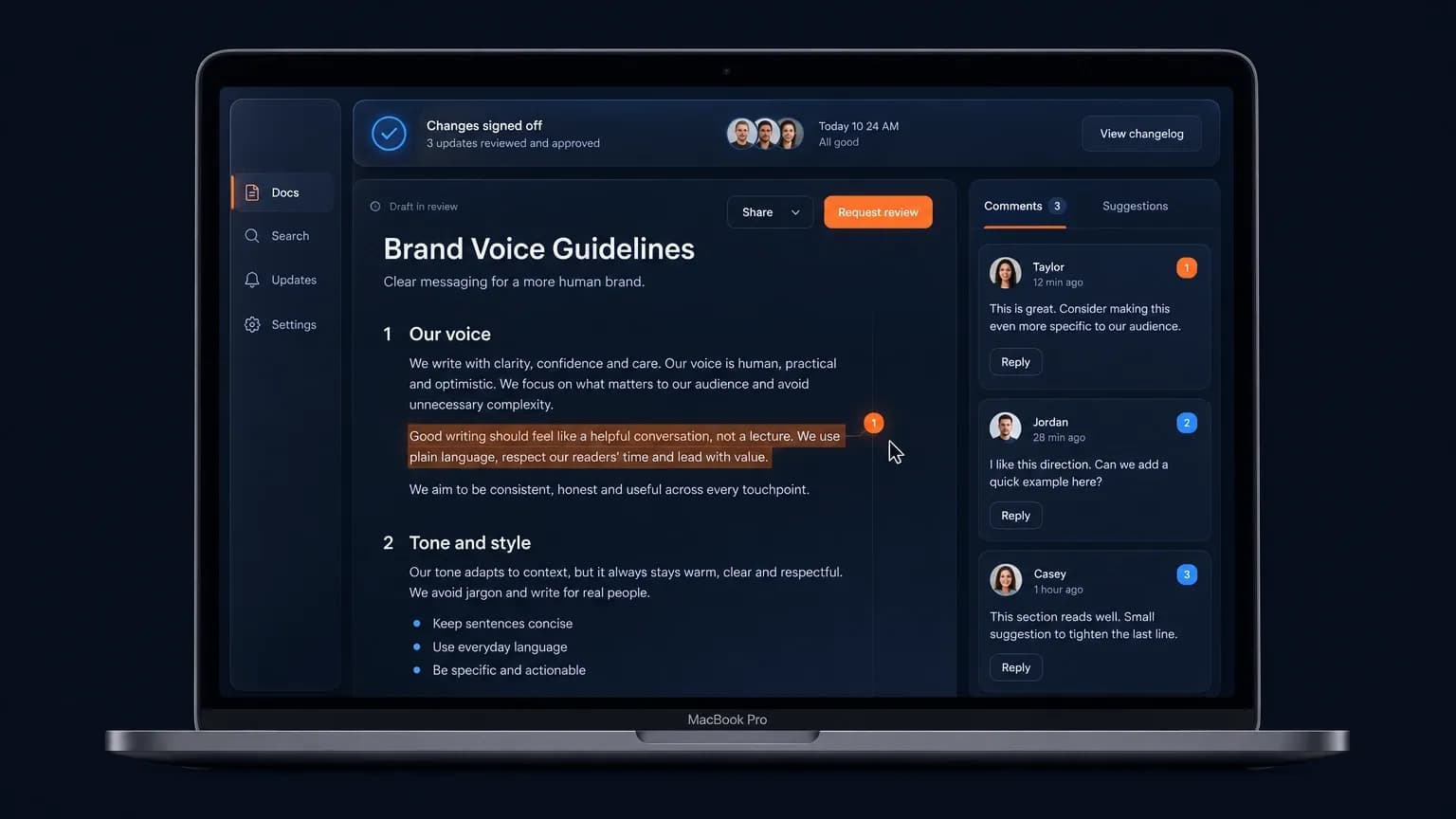
What no tool does is pronounce that sentence. No grammar checker will tell you a perfectly correct line is one no customer would ever say out loud, and no stack of SEO tools reads a draft for voice. Software finds the retired words and the missing numbers. The rest is a reader, and a reader needs somewhere to write down what they found.
Keeping the Document Alive (Versioning Without Chaos)
The version lane is empty in this field, and it is where most guides die. The five strongest pages on brand voice guidelines were searched for versioning, version history, changelog, sign-off and second reader. None of those terms appears, and owner shows up only as small business owner, never as the owner of the document.
Five rules keep a guide from becoming three guides.
- One canonical file, one name, one location. Anything else that looks like the guide is a copy, and copies get deleted the day they are found. Most drift comes from two files with different rules and nobody sure which one is current.
- A two-line changelog at the top. Date, what changed, who signed. No silent edits.
- Every rule change is a version bump, even a small one. If a writer cannot tell when a rule they memorized stopped being true, they will follow the old one and be right to.
- Retire rules, do not stack them. Guides die of accumulation more often than neglect. When a rule stops being true, delete it and say so in the log.
- Review on events as well as dates. A new hire, a new market, one launch that sounded off-brand. Reviewing once a year is a floor, not a plan.
You already hold one other document to this standard. You would not accept a marketing KPIs report where the definition of a metric changed halfway through the quarter without anyone saying so. A voice rule that quietly changes is the same problem, and it costs you a launch instead of a quarter.
Frequently Asked Questions
What should brand voice guidelines include?
Four things a reviewer can act on: principles written as decisions rather than adjectives, one before/after pair per principle taken from your own published copy, tone shifts listed per surface with the boundary that never moves, and the words you have retired. Add the named owner and a two-line changelog. A document built to be approved rather than used will pass any sign-off you put it through.
How is brand voice different from tone of voice?
Voice is what stays the same on every surface: your principles, your retired words, the promises you are allowed to make. Tone shifts by surface and by who is reading, so the same brand writes an error message and a launch post differently. Brand tone of voice guidelines describe that second column, and Mailchimp's style guide draws the line the same way before ranking its priorities out loud: clarity above entertainment. Say which one wins when they collide, or your writers will each decide for themselves.
How long should a brand voice guide be?
Long enough to hold every decision you can defend, short enough that a reviewer keeps it open. Published recommendations range from four to five pages (GatherContent, via the Content Marketing Institute) to fifteen, with eight to ten called the sweet spot for a company of five to fifty people by fullstop360. Most teams do not have fifteen pages of decisions, and one page of real rules beats ten pages of adjectives.
Conclusion
The numbers say your team is not the outlier. Adweek, carried by Gitnux, puts 46% of marketing professionals as unable to produce content that fully matches their brand guidelines, and the enforcement figures point the same way: about a quarter of companies with guidelines say they apply them consistently. That is the norm rather than your team's private failure.
The version that survives is the unglamorous one: four decisions, one pair of real sentences per decision, six questions a second reader can apply in three minutes, one name at the bottom, and a changelog nobody has to ask about. If most of your writing comes back from outside the building, content marketing services will follow the guide you hand them, and they will follow it literally.
So open your brand voice guidelines and count the sentences in them that could contradict a real draft. If the answer is zero, you do not need a better writer. You need a shorter document that somebody signs.