B2B Marketing Firms: How to Tell a Specialist From a Generalist Before You Sign
 Written by Martin J.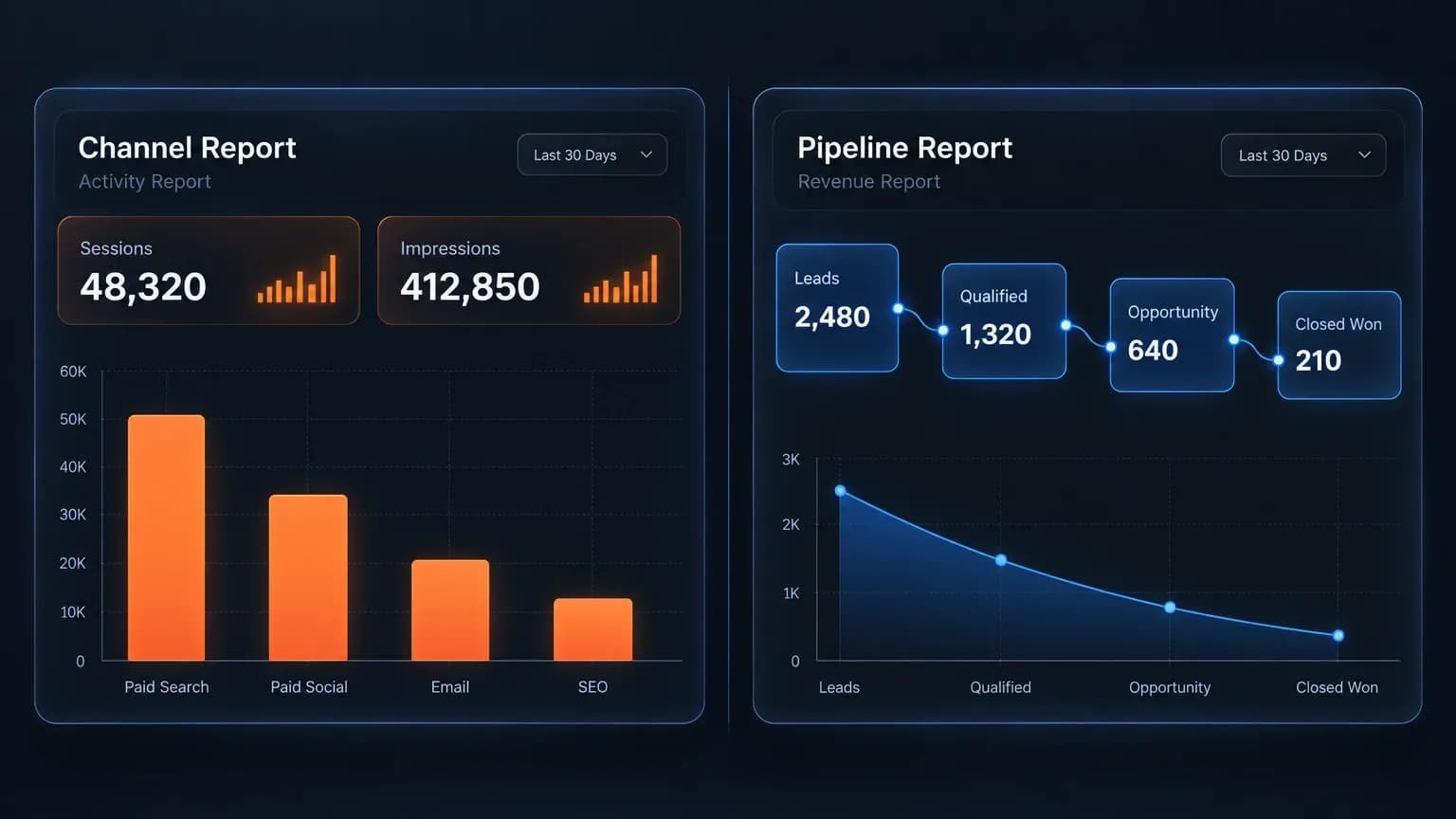
You have probably been in this meeting. Three agencies on a call, a deck each, and a slide that says trusted by followed by logos of companies ten times your size. You are the buyer, so the room waits for your nod. Here is the part nobody says out loud: those logos are proof the firm can absorb a big account, not proof it can run yours. Ranked lists of B2B marketing firms sort by headcount and revenue because size is the only thing a directory can measure from the outside. Fit is not in the data. So how do you tell, before you sign, whether the firm in front of you was built for a 45-day sales cycle or a two-year procurement? The four signals are already in the material they sent you.
You are the person a shortlist gets handed to, which means you are also the person expected to treat it as a recommendation. Six B2B marketing firms, ordered by something, in a sequence that starts to look like a ranking somewhere around the fourth name. What that order actually measures is headcount, gross income, review count, or how many contacts a directory has on file. Which of those six firms has ever run a sales cycle that looks like yours? You cannot answer that from the list, and neither could the person who gave it to you. A firm's size tells you what it can absorb, not what it is built to do for your deal. And the one thing every ranking surface in this category refuses to sort by is the thing you are actually buying.
Now look at who wrote the pitch. The best-written ones in this category come from authors who rank themselves first in the roundups those pitches quote, and the list you were handed was assembled by someone with a position. Enterprise procurement houses will still take your money, then staff the account with whoever is free that month. Not malice. Arithmetic, and invisible from the outside. Four signals that separate a firm built for your deal size from one built for a bigger one are already sitting in the material that firm sent you. None of them are on the shortlist.
What a B2B Marketing Firm Is Responsible For
A B2B marketing firm owns the demand side of a business that sells to other businesses. Practically, that means demand generation, pipeline content, account-based work, paid search and paid social, SEO and B2B SEO strategy, lifecycle email, and the reporting layer that ties all of it to revenue. The word doing the work in that sentence is "pipeline." Plenty of firms will run channels for you. Fewer will own a number your sales team recognizes.
The structure you are buying into has changed. Sagefrog's 2026 B2B Marketing Mix Report puts the hybrid model, part in-house team plus an outside firm, at 46% of B2B organizations, up from 36% a year earlier. It is now the most common arrangement in the category, and 70% of B2B marketers said their budgets rose in 2026.
That single number reframes the whole decision. You are no longer choosing between hiring in-house and hiring a firm, because most B2B teams already do both. The live question is narrower and harder: which firm, for which part of the work, at your deal size. A firm that cannot tell you what it should own, and just as clearly what you should keep, is selling breadth.
The harder half of that answer is the boundary. A useful B2B marketing agency will name the part of your program it should not touch: pricing conversations, product decisions, the parts of the sales process it cannot see. That tells you where its model stops, and it is the same information you need to budget for what stays internal.
Specialist or Generalist? Four Ways to Tell

Every ranking surface a B2B buyer encounters sorts firms by size. League tables go by gross income and growth rate, directories by review volume or contacts tracked, trade roundups by headcount. Nothing on the page you were handed sorts by fit, which is why the label "specialist" gets applied so loosely. Nearly every B2B marketing agency claims it. It usually means one industry logo, not one way of working.
The distinction worth paying for is narrower. A specialist is built around a buying motion. A generalist is built around a set of services. You can tell which one you are talking to without asking a single question, because both leave evidence in what they have already produced. Four things to inspect:
What you inspect | Where it comes from | Specialist signal | Generalist signal |
|---|---|---|---|
Reporting structure | A sample monthly report, or the report page in a pitch deck | Opens on pipeline: qualified conversations, opportunity value, stage movement, closed revenue | Opens on channel metrics: impressions, clicks, sessions, followers, engagement rate |
Sales-cycle language | The people in the pitch, and the questions they ask you | Asks how long your deal takes, how many people sign, what kills a deal late | Asks your budget, your goals, and which channels you are interested in |
Channels they refuse | Their service list, compared against what they recommend for you | Names a channel it will not sell you, and explains why it is wrong for your motion | Recommends every channel on the menu, weighted slightly toward the biggest one |
Reference relevance | Case studies, with the deal size and cycle stated | References look like you: similar contract value, similar committee size | References are logos, with no deal size attached |
Pipeline reporting instead of channel reporting
Ask for one recent monthly report, redacted if needed, and look at what fills the first page. It is the fastest way to tell B2B marketing companies apart. Channel reporting shows a firm that is paid to grow activity, and activity is what it will optimize. Pipeline reporting shows a firm that has agreed to be measured on revenue it influenced, which is a riskier promise and a much more expensive one to break.
There is a plumbing requirement under that. If the report claims pipeline influence, ask what produced the attribution: a self-reported form field, a first-touch model, or a tool that separates influence from correlation. Getting demand generation vs lead generation backwards is expensive, and marketing attribution software is the wrong purchase until you know which model you need. A firm that reports pipeline without attribution plumbing is describing a dashboard, not a result.
Sales-cycle literacy
Listen for how the firm describes a typical customer. A generalist describes a set of jobs: SEO, paid search, content, email. A firm built for a buying motion describes a sequence: who enters the process, what they read first, where the deal stalls, what shortens the second conversation. The second description cannot be produced by someone who has never sat close to a sales team, and it shows up in the first ten minutes.
A firm that never asks about your cycle is a firm that will run your account the way it runs everyone else's. This is the single biggest predictor I have seen, and it is far more reliable than the industry logos on the deck. The buyer's own research backs it from the other direction: 6sense's 2026 B2B Buyer Experience Report puts roughly 70% of the decision journey complete before a buyer ever makes first contact, which means a firm that does not understand how your buyer moves will be optimizing for a moment that has already passed.
Which channels they refuse to sell you
This is the highest-signal test on the list and the fastest to run. It is also the easiest place to spot a true narrow specialist: a B2B SEO agency will decline paid social work in a way a generalist never does, and it will say so on the first call. Hand a specialist a brief for a channel it does not run properly and it declines the work. Hand the same brief to a generalist and it says yes, then subcontracts or learns on your budget.
Refusal is uncomfortable to sell, which is exactly why it is credible. A firm that says it will not run display for you because your buyer does not convert on it, or that it will not take a retainer for a channel where it cannot show incremental gain, is telling you where its model ends. That boundary is the shape of its specialization. If every channel in your brief is answered with "we can do that," you are not buying expertise, you are buying capacity.
Reference customers in your deal size
Client logos prove a firm has worked with large companies. They do not prove it can work with you. Look at the case studies for two facts: the contract size behind them and the length of the sales cycle they ran. A firm that has run six-figure enterprise programs for two-year cycles does not automatically know how to run a $6,000-a-month program for a 45-day cycle.
That is why the logos always look impressive and tell you so little. What you want to see is a case study whose contract value sits in your range and whose sales cycle ran at your length. If you sell through a self-serve or low-touch motion, a SaaS marketing agency reference set is closer to your reality than an enterprise one, and a startup marketing agency is closer still if you are pre-revenue or under a few million.
What B2B Marketing Firms Cost, and What the Width of the Band Tells You

Two firms can quote you the same monthly number and be selling you completely different things. What separates them is not the figure, it is the width of the range they work in. A narrow range usually means someone priced the work. A wide one usually means someone priced the hours.
The commonly cited 2026 retainer range for B2B sits between $2,500 and $15,000 per month, with single-channel work at the bottom of it and full go-to-market engagements well above $10,000. Project work and hourly rates spread wider still. None of those numbers is a price, which is the point.
Now read those bands as a diagnostic rather than a price list. A true specialist can usually narrow its range and explain why one program shape costs less than another: fewer moving parts, a shorter feedback loop, a smaller senior team. A generalist quotes the same figure for PPC management services as for a full go-to-market program, because its pricing is based on hours or deliverables rather than on how the work actually works.
Two numbers make the point sharper. Hidden costs, meaning setup fees, ad spend minimums and required tool subscriptions, commonly add 20 to 40% beyond the quoted retainer, according to SaaS Hero's 2026 analysis. And the average cost of scope creep per mid-size agency project is around $8,700, with 68% of agencies reporting they discover overruns too late, according to 2026 agency profitability benchmarks. A firm that cannot state its scope precisely is a firm whose quote will move. That is what happens when a firm sells breadth it has to subcontract.
Where Most B2B Firms Fail Their Clients
Almost nobody in this category fails clients through incompetence. They fail through mismatch, and the churn data shows the pattern clearly.
Focus Digital's 2026 average agency churn report measures annual client churn by service type. Full-service digital marketing carries 25% churn, the lowest in the study. SEO sits at 38%, content marketing at 35%, email at 41%, social media at 46%, and paid advertising (PPC) at 49%, the highest. The report's explanation is switching cost: a full-service firm touches more of your operation, so leaving is expensive. A single-channel firm is easy to replace, so it gets replaced.
Read that carefully, because it inverts the obvious conclusion. Narrow and specialized is not automatically stickier. The most measurable, most easily compared service in the category is the most churn-prone. So the answer is not "hire a specialist." The answer is "match the specialization to the part of the work you genuinely cannot do yourself," and then read the breadth of a firm's scope as a signal about how it delivers. A specialist whose service is your actual bottleneck is a strong hire. A specialist whose service is not your bottleneck is an expensive experiment with a nine-month half-life.
The timing of the failure matters too. Moxo's 2026 research into B2B churn found that 43% of client churn happens inside the first 90 days of a relationship. Nearly half of the damage is done before a quarterly review has even happened. That is the strongest argument available for running the four checks above before signature rather than after the first invoice. By the time you can see the problem in a report, most of the money is already committed.
One failure mode is worth naming on its own, because it is the easiest to screen for and the hardest to see in a pitch. The people who sold you the work are often not the people who run it. The closer who understood your sales cycle and your buying committee hands the account to a delivery team that has never met you, and the seniority you were shown in the pitch becomes a quarterly call. Ask who will be in your account team, by name, and ask whether they were in the room when the strategy was written.
In-House, Freelancer or Firm?
This is not the question most buyers think they are answering, because 68% of brands already run some in-house capability, per RevenueMemo's 2026 agency statistics. The realistic choice is about which slice of the work goes outside.
The budget context explains why that slice keeps getting discussed. Gartner's 2026 CMO Spend Survey, drawn from 401 CMOs, puts marketing budgets flat at 7.8% of company revenue, unchanged from 7.7%. The CMO Survey's January 2026 wave, run by Duke Fuqua with Deloitte and the AMA, measures 9.0% and splits it by segment: B2B services at 10.1% of revenue, the highest measured, and B2B products at 7.0%, the lowest. Treat the honest range as roughly 7 to 10%, and note that the Gartner sample skews above $1 billion in revenue.
The number that actually decides the split is labor. Gartner found labor's share of the marketing budget rose from 21.9% to 24.5% year on year, while 70% of CMOs said their internal marketing processes are not mature enough to scale AI, and 38% named lack of internal AI expertise as their top barrier. Only 30% reported mature AI readiness. That is a team at capacity, not a team looking to outsource everything.
So the practical split looks like this. Keep the work that requires your product knowledge, your customer relationships and your pricing judgment in-house, because no external firm will hold that context as tightly as your own team. Send out the work that is repeatable, measurable and hard to staff locally: usually production, technical SEO and paid media execution. A freelancer fits one narrow, well-defined task with a fixed end. A firm fits ongoing work that spans several disciplines and needs a named owner.
Building the Shortlist Without a Directory
The reason your shortlist felt like a ranking is structural. In the current results for B2B marketing firms, eight of the twelve non-local organic results are published by an author that ranks itself first in its own list, or by a directory that charges the listed firms. Trade league tables rank by gross income and year-on-year growth. Directories rank by review count. One newer entrant ranks firms by how many contacts it has on them. Every surface sorts by size, and not one sorts by fit.
The demand signal is visible in the same place. A peer forum thread asking for agencies a buyer can actually trust ranks organically in this category and is also cited by Google's AI Mode panel when that panel assembles its own shortlist. Buyers are asking each other because the published rankings do not answer their question, and the AI surface is answering by stitching those same biased lists together into what looks like a neutral recommendation.
The AI layer raises the stakes on getting it right the first time. Averi's March 2026 analysis of 680 million citations puts AI tool use in B2B buying research at 73%, and Crackle PR's Q2 2026 benchmark found 51% of B2B tech brands have zero citations across the major AI platforms. The average vendor shortlist has contracted from about 3.2 names to 2.5. Discovery is narrowing while the choice stays hard, which is the argument for a test you can run yourself.
So build the list differently. Start from the bottleneck, not from a directory. Name the one outcome you cannot produce internally in the next two quarters, then find firms whose published output shows they have produced that exact outcome for a company at your deal size. Use directories as a source of names rather than a source of order, and run the four checks before the first call rather than after the third.
One practical consequence of all this: the checks run on material a firm has already given you. Ask for a redacted monthly report, two case studies with contract values, and the names of the people who will actually run your account. A firm that stalls on any of those has answered the question already, and you have your answer before you spend a quarter finding out the slower way.
Conclusion
The shortlist you were handed was never neutral, and the label on the firm does not settle the question either. What settles it is evidence you can inspect before signature: whether a B2B marketing firm's reporting opens on pipeline or on channels, whether the people in the room understand how your deals actually close, whether the firm will refuse to sell you something, and whether its reference customers operate at your deal size. Four checks, run on one firm at a time. That is the whole test.
Run it before the second call, while you still have a choice. The 43% of churn that lands in the first 90 days is decided at signature, and no agency will run this test for you.
FAQ
What does a B2B marketing firm do?
It owns demand generation for a company that sells to other businesses: pipeline content, account-based programs, paid search and paid social, SEO, lifecycle email, and the reporting that connects that activity to revenue. The definition is easy and almost useless on its own, because the difference between two firms answering it the same way is in scope and in what they measure. Ask what they own end to end, and what they expect your team to keep.
How much do B2B marketing agencies charge?
Published 2026 bands put most monthly retainers between $2,500 and $15,000, with single-channel programs at the bottom of that range and full go-to-market engagements above $10,000. Project work and hourly rates vary widely, and hidden setup, platform minimum and tooling costs can add 20 to 40% on top of the quoted figure. Treat any single "average" number you are given with suspicion, including from a firm that should know. The band shape is more informative than the number: a narrow band with a reason behind it tells you the firm knows what it is selling.
Should a startup hire a B2B marketing firm?
Usually not first, and not for the whole job. A pre-revenue or early-stage company is better served by one narrow, well-defined engagement, often a single channel or a content engine, than by a broad retainer that assumes a sales process already exists. The exception is a founder who has proven the motion and needs production capacity rather than strategy. If that is where you are, look for a firm whose references include companies at your stage rather than logos from a company you are not yet.

Put the test to work
If you are still deciding what to keep in-house, start with the part of the work you can measure. Allable runs your research, content and reporting in one workspace, so you can see what your own team produces before you hand it to anyone else.